María Isabel Santos: The Resilient Story of Pablo Escobar’s Wife
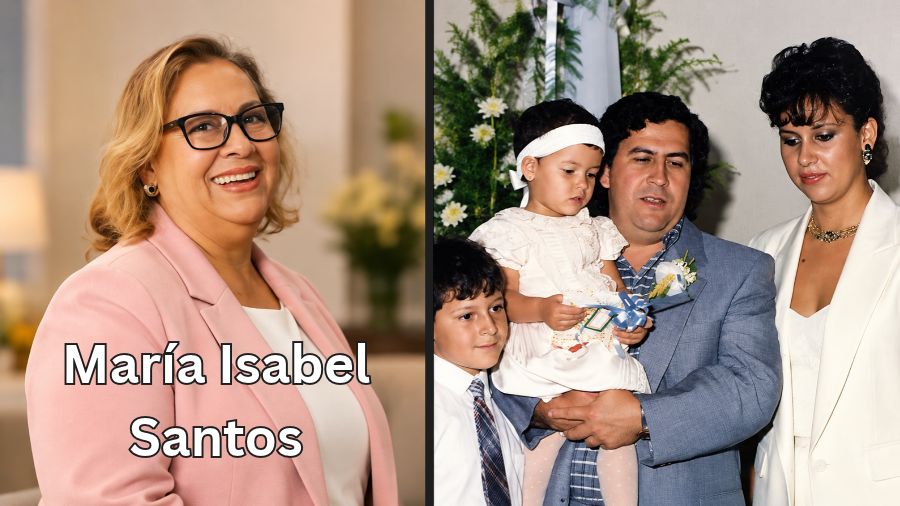
María Isabel Santos, formerly known as María Victoria Henao Vallejo, is widely recognized as Pablo Escobar’s wife and the mother of his two children, Sebastián Marroquín and Manuela Escobar. Her life has attracted international attention because of her marriage to Colombia’s notorious Medellín Cartel leader, the family’s years of insecurity, their relocation to Argentina after his death, and her later decision to share her experiences through writing and public appearances. Beyond the historical notoriety surrounding her husband, Santos’s story offers a perspective on family life, personal identity, exile, and the long-term consequences of living alongside organized crime.
Quick Bio
| Fact | Details |
|---|---|
| Full Name | María Isabel Santos Caballero, formerly María Victoria Henao Vallejo |
| Known As | María Isabel Santos; Victoria Eugenia Henao is also used in some public accounts |
| Profession | Author, speaker, and ontological coach, according to public profiles |
| Nationality | Colombian-born; later resident of Argentina |
| Birthplace | Colombia; a more specific birthplace is not consistently established in reliable public biographies |
| Birth Year | Commonly reported as 1961, although published accounts differ |
| Education | Detailed formal education has not been reliably disclosed in widely available biographies |
| Spouse | Pablo Escobar, whom she married in 1976 |
| Children | Sebastián Marroquín and Manuela Escobar |
| Known For | Her marriage to Pablo Escobar, memoir, and public reflections on her life |
| Relationship to Pablo Escobar | Wife and later widow |
| Current Residence | Public accounts associate her with Buenos Aires, Argentina |
| Current Status | Publicly known as an author and speaker; details of her private life remain limited |
| Public Presence | Interviews, memoir-related appearances, conferences, and discussions about personal transformation |
| Notable Book | Mi vida y mi cárcel con Pablo Escobar, published in Spanish |
Who Is María Isabel Santos?
María Isabel Santos is the name adopted by the woman born María Victoria Henao Vallejo, who became internationally known through her marriage to Pablo Escobar. Although Escobar’s criminal activities, wealth, and violent confrontation with Colombian authorities dominate accounts of the Medellín Cartel, Santos’s life has also drawn attention because she experienced the consequences of that world as a wife and mother. She married Escobar as a teenager, raised two children during years of escalating danger, and eventually left Colombia following his death in 1993. Her subsequent life in Argentina brought new challenges involving anonymity, family security, and legal scrutiny. In later years, she began discussing her experiences publicly, presenting her story as a personal account of fear, difficult choices, and rebuilding an identity separate from her husband’s reputation. Her life is therefore relevant not only to readers researching Pablo Escobar’s wife but also to those interested in the human consequences of organized crime and the challenges faced by families connected to notorious public figures.
Background in Public Life and Personal Development
María Isabel Santos did not initially become known through an independent public career; her early public identity was closely connected to her marriage and family circumstances. Her childhood in Colombia preceded a relationship with Escobar that began when she was very young, and her life subsequently unfolded within the growing influence of the Medellín Cartel. After relocating to Argentina, she maintained a relatively private profile for many years, although her family’s past remained a subject of public interest. In later life, she became more visible through her memoir, interviews, speaking engagements, and work described in public profiles as ontological and organizational coaching. These activities have allowed her to discuss personal development, identity, and the psychological effects of difficult experiences. However, reliable public information about her formal academic qualifications, professional certifications, and the complete history of her coaching career is limited, so those details should not be presented as established facts without additional verification.
Marriage or Relationship with Pablo Escobar
The relationship between María Isabel Santos and Pablo Escobar began when she was approximately 12 years old and he was around 23, according to widely published biographical accounts. Their relationship developed during her adolescence, and they married in March 1976, when she was reportedly 15 and Escobar was 26. Her family reportedly opposed the relationship, particularly because of the substantial age difference, but the couple proceeded with the marriage. As Escobar’s criminal operations expanded, their family life became increasingly affected by violence, security concerns, and the demands of remaining out of reach of rivals and law enforcement. Santos has described a complicated marriage in which material wealth existed alongside fear, restrictions, and personal difficulties. Reports also describe Escobar’s infidelity and relationships outside the marriage. Understanding their relationship requires distinguishing Santos’s own recollections from dramatized television portrayals and accounts written by other people. Her perspective is significant because it provides a family-centered account of a period usually discussed through crime, politics, and law enforcement.
Parenthood and Family Life
María Isabel Santos and Pablo Escobar had two children, Sebastián Marroquín and Manuela Escobar, whose lives were profoundly affected by their father’s criminal notoriety and death. Their son was born Juan Pablo Escobar Henao in 1977 and later adopted the name Sebastián Marroquín after the family left Colombia. Their daughter, Manuela Escobar, was born in 1984 and has generally remained much less visible in public life. During Escobar’s lifetime, the family experienced considerable wealth but also the uncertainty associated with his enemies, security threats, and repeated changes in circumstances. Following his death in December 1993, Santos faced the difficult task of protecting her children while seeking a place where they could begin again. Their eventual relocation to Argentina required the family to live under assumed identities and distance themselves from their former public associations. Sebastián later became an architect and author who has spoken publicly about his father, while Manuela has largely avoided public attention. Reliable details about her current personal circumstances and professional activities remain limited, and respect for her privacy is important when discussing the family.
Supporting Through a Life Shaped by Fear and Uncertainty
Santos’s experiences during her marriage illustrate the difference between the public image of a wealthy criminal household and the private pressures described by people who lived within it. Escobar’s position as the leader of the Medellín Cartel brought enormous resources but also placed his family in an environment shaped by criminal rivalries, violent retaliation, and government pursuit. Santos has described the restrictions and emotional burdens associated with living under these circumstances, including the difficulty of maintaining ordinary family routines. Her role should not be simplified into either an endorsement of her husband’s activities or a claim that she had complete control over the decisions surrounding their household. Publicly available accounts cannot establish every private choice she made or the extent of her knowledge of individual criminal operations at every stage. What can be said is that her later recollections focus on the consequences of living within that environment and the challenges of protecting her children. Her story adds a personal dimension to the history of the Medellín Cartel without diminishing the harm caused by its violence.
Life After Pablo Escobar’s Death
Pablo Escobar died on December 2, 1993, during a confrontation with Colombian security forces in Medellín. His death did not immediately end the danger facing his wife and children, who had reasons to fear retaliation and continued public exposure. Santos and her family attempted to leave Colombia and find a country where they could live safely, but establishing a permanent home proved difficult. Public accounts describe efforts to obtain refuge in different countries before the family eventually settled in Argentina in the mid-1990s. They adopted new identities, and Santos became known as María Isabel Santos Caballero. The move represented a major break from their former life, but it did not erase their association with Escobar or prevent future media attention. Over time, the family encountered renewed scrutiny, including Argentine legal investigations concerning alleged financial dealings. Santos’s post-1993 life is best understood as an ongoing effort to create distance from her husband’s legacy while navigating the practical and emotional consequences of that history.
Career Highlights and Public Recognition
Santos’s later public profile developed through her memoir, interviews, and speaking appearances rather than through a long-established entertainment career. Her Spanish-language memoir, Mi vida y mi cárcel con Pablo Escobar, recounts her experiences of marriage, family life, and the consequences of Escobar’s criminal world. English-language references use translated or alternative titles, including My Life and My Prison with Pablo Escobar and Pablo and Me: My Life with Escobar. Readers should check the particular edition when citing a title because translations and publishing descriptions can vary. Her public discussions have addressed the contrast between material privilege and personal insecurity, the difficulties of exile, and the process of building a life after trauma. Some profiles describe her as an ontological and organizational coach, and she has appeared in interviews and forums discussing personal development. These public activities offer insight into how she presents her experiences today, but they do not independently verify every detail of her private history or professional credentials.
Why People Search for María Isabel Santos
Interest in María Isabel Santos is closely connected to the continuing global fascination with Pablo Escobar, the Medellín Cartel, and the history of Colombia’s drug trade. People searching for Pablo Escobar’s wife often want to understand how their marriage began, what family life was like, and what happened to the couple’s children after 1993. Others are interested in her adopted name, her relocation to Argentina, her memoir, or the legal investigations that later brought renewed attention to the family. Television dramas and documentaries have also encouraged audiences to compare fictional portrayals with the experiences described by real people. These comparisons should be approached carefully because dramatizations compress timelines, combine events, and create scenes for narrative purposes. Santos’s own public accounts are valuable as personal testimony, but they should be considered alongside independently reported historical information. The strongest biography acknowledges the public interest in her connection to Escobar while avoiding sensational claims, unsupported psychological conclusions, and speculation about matters she has not publicly disclosed.
Privacy, Accuracy and Public Information
A responsible account of María Isabel Santos must distinguish established historical events, reported biographical details, her own recollections, and allegations that arose in legal proceedings. Her marriage to Escobar, the birth of their children, his death in 1993, and the family’s later life in Argentina are widely documented, although some personal details differ across publications. Her birth year is commonly reported as 1961, but discrepancies exist in public accounts, and her full educational history has not been reliably established. Names also require care: María Victoria Henao Vallejo is widely associated with her birth identity, María Isabel Santos Caballero is her adopted name, and some sources use Victoria Eugenia Henao. Her parents’ names are reported in some biographies as Carlos Mario Henao Vallejo and Pastora Henao Bayen, but those details should be independently checked before being treated as definitive. Argentine investigations involving Santos and her son concerned allegations of financial misconduct; an allegation or charge must not be described as a conviction without reliable confirmation of the outcome. Similarly, claims about her current residence, employment, finances, or family relationships should not be expanded beyond what credible public sources support. Accuracy means acknowledging uncertainty rather than filling gaps with assumptions.
Conclusion
María Isabel Santos’s life is closely linked to one of the most notorious figures in modern criminal history, but her personal story also includes motherhood, displacement, legal scrutiny, and an effort to establish a different identity. As Pablo Escobar’s wife, she experienced the privileges and dangers associated with his rise, while her life after his death required her family to leave Colombia and build a future elsewhere. Through her memoir and public appearances, she has shared her interpretation of those experiences and discussed the process of personal transformation. Her account should neither replace the broader historical record nor be reduced to the sensational image of Escobar’s household. A balanced understanding recognizes the distinction between her husband’s documented crimes, her own public statements, and details that remain uncertain. For readers researching María Isabel Santos, the most informative approach is to consider her family history, her life after 1993, and her later public work while respecting the limits of verified information.
FAQs
1. Who is María Isabel Santos?
María Isabel Santos Caballero is the widow of Colombian drug lord Pablo Escobar, a memoirist and speaker who has discussed her family history and life after his death.
2. When did María Isabel Santos marry Pablo Escobar?
Published biographical accounts state that María Victoria Henao married Pablo Escobar in March 1976, when she was approximately 15 years old.
3. How many children did María Isabel Santos have?
She had two children with Pablo Escobar: Sebastián Marroquín, formerly Juan Pablo Escobar Henao, and Manuela Escobar, born in 1984.
4. Why did María Isabel Santos change her name?
After Escobar’s death, she adopted a new identity as the family sought security, privacy, and distance from the criminal legacy associated with his name.
5. Where did María Isabel Santos move after Escobar died?
Santos and her children eventually settled in Buenos Aires, Argentina, during the mid-1990s after facing difficulties finding a safe place outside Colombia.
6. What is María Isabel Santos known for today?
She is known for her memoir, interviews, and speaking appearances in which she discusses her experiences, personal development, family history, and life after Escobar.
More read: Alexander James Caan