Target Company URL Research: A Complete Guide to Finding Business Websites
Target Company URL Research helps businesses, marketers, SEO professionals, and sales teams identify the official websites of companies they want to investigate. Whether you are building a prospect database, researching competitors, planning a guest-posting campaign, or organizing business leads, finding accurate company URLs is an important first step. Understanding how company URL research works, which tools can simplify the process, how to verify domain matches, and what limitations to consider can help you build more reliable business data and make better-informed decisions.
What Is Target Company URL Research?
Target Company URL Research is the process of identifying the correct website associated with a specific business or organization. It can involve searching for a company by name, comparing potential domain matches, checking official business information, and recording the verified URL in a structured database. The phrase can describe a general research activity or refer to a specific online tool that helps automate company-domain discovery. The goal is to connect a business name with its most relevant official web presence rather than relying on guesses or unrelated search results.
Why Company URL Research Matters
Accurate company website data supports a wide range of business activities, from finding potential customers to analyzing competitors and identifying suitable websites for digital marketing campaigns. When a company database contains incorrect domains, employees may waste time contacting unrelated businesses, evaluating the wrong competitors, or sending outreach messages to unsuitable prospects. Reliable URL research reduces these avoidable errors and gives researchers a consistent starting point for further investigation. It is particularly useful when working with large prospect lists, where checking every company manually can become time-consuming.
Finding the Right Business Website
A company name does not always reveal its official website. Businesses may use shortened brand names, different legal names, regional domains, or websites that do not exactly match their registered names. Some companies also share similar names with unrelated organizations. Company URL research helps distinguish these possibilities by comparing the business name with its website, location, industry, branding, and other available information. This verification is important because a plausible-looking domain is not necessarily owned or operated by the business being researched.
Supporting Better Business Decisions
A verified company URL provides a starting point for understanding an organization’s products, services, target audience, market positioning, and online presence. Sales teams can use it to prepare relevant outreach, while marketers can assess potential partners and publishers. SEO professionals can review competitors’ content and website structures, and researchers can organize organizations by industry or geographic market. Although a website alone cannot establish a company’s financial health, reputation, or suitability as a partner, it provides a useful source of publicly available information for further evaluation.
Key Features of Target Company URL Research
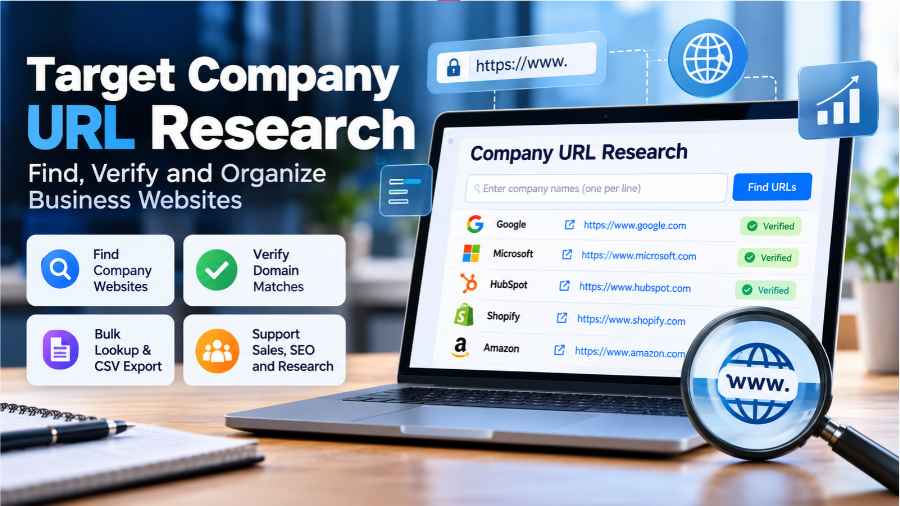
Target Company URL Research is designed to simplify the process of matching business names with potential website domains. The tool’s published features include bulk company lookup, name-match scores, alternative candidate suggestions, CSV export, a careers-page finder, an industry-based brand directory, and country-based company browsing. Its lookup interface supports up to 25 company names per run and uses the Clearbit Autocomplete service as its stated data source. These capabilities make it useful for initial prospect research, although users should distinguish automated matching from independent verification of a company’s identity.
Bulk Company URL Lookup
Bulk lookup is useful when a researcher already has a list of businesses but lacks their website addresses. Instead of searching for each company individually, users can paste multiple names into the lookup interface and review the suggested domains together. The tool also describes cleaning company names by removing duplicates and common legal suffixes, such as LLC, Ltd, Inc, and GmbH. This can improve consistency when working with lists collected from spreadsheets, directories, or business databases. However, results may be incomplete for small businesses, new startups, or organizations that are not represented in the underlying data source.
Company Name-Match Scores
Match scores help users decide which results deserve closer inspection. A strong textual match indicates that the returned company name resembles the submitted name, while a weaker match signals greater ambiguity. This is particularly important for common business names, abbreviations, and brands that operate in several industries. A match score should not be interpreted as a verified ownership certificate, a measure of company credibility, or a guarantee that the domain is correct. Researchers should open the proposed website and compare its identity, services, contact information, and other relevant details before accepting the result.
Alternative Domain Suggestions
Alternative suggestions can help when a company has a name that overlaps with other brands or organizations. Rather than accepting the first result automatically, users can compare other candidates and determine which one best matches the business they intended to research. This feature is valuable when investigating international businesses, parent companies, subsidiaries, and organizations with similar trading names. The correct choice should be supported by evidence such as location, product offerings, branding, or an official company profile. If the available suggestions remain ambiguous, a separate manual search is preferable to selecting an uncertain domain.
CSV Export for Business Data
CSV export allows researchers to move lookup results into spreadsheet applications and business workflows. A structured file can help teams review company names, matched names, domains, and confidence labels before adding records to a customer relationship management system. This is useful for organizing prospect lists, removing duplicates, assigning verification tasks, and preparing future research. Nevertheless, exporting data does not make it accurate automatically. Teams should retain a verification status and, where appropriate, a review date so that uncertain or outdated URLs can be checked before they are used in important business decisions.
Careers Page Finder
The careers-page finder generates common URL patterns that companies may use for recruitment pages. It can help job seekers locate official employment information and help researchers investigate publicly visible hiring activity. However, generating a likely careers URL is different from checking whether the page exists or whether a position is currently available. Businesses may use custom paths, external recruitment platforms, or dedicated subdomains. A generated link may therefore lead to an unavailable page. Users should open the destination and review the actual job listings rather than treating a suggested careers address as proof that the company is hiring.
Brand Directory and Country-Based Search
A curated brand directory can help researchers discover established companies within an industry, while country-based browsing can narrow a shortlist by headquarters location. These features are useful during early-stage market research when the user has not yet prepared a list of specific organizations. However, curated directories are not necessarily exhaustive or continuously updated. A company may be missing, recently renamed, acquired, or incorrectly associated with a location. Researchers should treat directory results as starting points and verify important details before using them to define a target market or build a comprehensive competitor list.
How to Use Target Company URL Research Step by Step
The most effective workflow combines automated discovery with human review. Start with a clear list of company names, run the lookup, inspect the suggested domains, and export the results only after reviewing uncertain matches. This approach makes it easier to identify mistakes before they spread into sales records, marketing lists, or research reports. For important prospects, verify the company’s identity through additional public information and record any unresolved questions. The purpose is not simply to produce a long list of URLs; it is to create a dependable set of business records that can support the next stage of research.
Step 1: Prepare a Clean Company List
Begin with one company name per line and remove blank rows, duplicate entries, and unnecessary formatting. Use the recognizable trading name when possible, especially when the legal entity has a long or complicated name. Include a country, city, or industry in a separate spreadsheet column when you already know that information, as it can help resolve ambiguous results during manual review. Do not combine unrelated companies into one entry. A clean input list makes it easier to compare results and reduces confusion when similar names appear in the output.
Step 2: Run the URL Lookup
Enter the prepared names into the lookup interface and process the list within the tool’s stated limit of 25 names per run. Review the returned company names and domains instead of assuming that every result is correct. When the tool offers alternative candidates, compare them before selecting a match. If a company is not found, try a commonly used trading name or a different spelling. A missing result does not necessarily mean the company has no website; it may simply be absent from the underlying database or listed under another name.
Step 3: Verify the Official Website
Open each important result and look for consistent evidence connecting the domain to the intended company. The homepage, About page, Contact page, privacy policy, and legal information may reveal the business’s name, location, services, and other identifying details. Compare these details with independent sources where possible. HTTPS is important for secure connections, but it does not by itself establish that a website belongs to a particular company. If the available evidence conflicts or remains inconclusive, mark the record as unresolved rather than assigning it an unsupported level of certainty.
Step 4: Export and Organize the Results
After reviewing the matches, export the results into a CSV file and open it in a spreadsheet application. Keep the original company name alongside the matched name and domain so that differences remain visible. Add fields for verification status, country, industry, source checked, and last-reviewed date if these details matter to your workflow. Separating confirmed matches from uncertain ones helps prevent mistakes when the data is shared across a team or imported into a CRM. For larger projects, establish a consistent review process before combining records from multiple lookup sessions.
How to Verify Whether a Company URL Is Genuine
Automated matching is most valuable when paired with reliable verification. A domain may look relevant because it contains a brand name, yet belong to a reseller, unrelated organization, affiliate website, or impersonator. Verification should therefore focus on whether the available evidence consistently connects the website with the specific company under investigation. For business-critical records, compare the website with independent sources and preserve the evidence used to make the decision. If the company’s identity cannot be established confidently, keep the record flagged for further review instead of presenting a likely match as a confirmed official domain.
Check the Company Name and Contact Details
Start by examining the website’s About and Contact pages, including any legal entity name, business address, telephone number, and company email address that it publishes. Compare these details with reliable company profiles or official registration records where available. A consistent set of details provides stronger evidence than a matching logo or page title alone. Some legitimate companies use separate brands, regional sites, or shared corporate addresses, so differences should be investigated rather than automatically treated as proof of fraud. The aim is to establish a reasonable connection between the website and the intended business.
Review Independent Company Profiles
Official social profiles, regulatory filings, government business registers, recognized industry directories, and reputable news coverage may help corroborate a company’s website. A domain referenced by multiple independent sources is generally more convincing than one found only in a generic directory. Researchers should check that these sources refer to the same organization and are not confusing a subsidiary with its parent company or one business with another that has a similar name. Independent verification is especially important when collecting data for investment research, procurement, large sales opportunities, or partnerships where inaccurate company identification could have significant consequences.
Understand Redirects and Regional Domains
Some companies maintain multiple domains for different countries, languages, products, or brands. Others redirect older websites to a new domain after a rebrand, acquisition, or website migration. A redirect can provide useful evidence about a company’s online presence, but it should be reviewed carefully to ensure that the destination is relevant and legitimate. Researchers should record the preferred official website for their purpose and note regional alternatives when they matter. A different domain extension or URL structure does not automatically mean a website is unofficial, just as a familiar brand name in a URL does not guarantee authenticity.
Practical Uses of Company URL Research
Company URL research is useful whenever an organization needs to identify businesses before taking a further action. The value comes from creating an accurate starting point for investigation rather than treating a domain as a complete company profile. Different teams can use the same verified URL data for different purposes, including lead generation, competitor analysis, recruitment, procurement, and market mapping. The research process should be adapted to the intended outcome because a domain suitable for an initial prospect list may require additional verification before it is used in a financial assessment or formal business decision.
SEO and Guest-Posting Prospect Research
SEO professionals and guest-posting agencies can use company URL research to identify websites belonging to potential publishing partners, marketing agencies, brands, and businesses in relevant industries. Once a domain has been identified, the researcher can assess whether the website publishes useful content, serves the intended audience, accepts external contributions, and has a credible editorial presence. Finding a URL is only the first step: it does not establish that a website accepts guest posts, sells placements, or offers valuable search visibility. Each publisher must be evaluated separately for content quality, relevance, transparency, and compliance with applicable search engine guidelines.
B2B Sales and Lead Generation
Sales teams often begin with a list of target accounts before identifying decision-makers or preparing outreach. Company URL research helps connect those names to websites where teams can examine products, customer segments, business models, and publicly available contact information. This context can make sales communication more relevant and reduce errors caused by confusing similarly named organizations. However, a verified domain does not automatically provide an employee’s email address, prove that a company is an appropriate prospect, or establish that it has purchasing authority. Those details require additional research using suitable sources.
Competitor and Market Research
Businesses can use company domains to build an initial list of competitors and then compare their product offerings, positioning, website content, pricing information, and geographic reach. Researchers may also discover adjacent businesses serving similar audiences or solving related customer problems. The resulting analysis can inform content planning, product development, and market positioning. However, simply finding companies in the same industry does not establish that they compete directly. A meaningful comparison should consider customer needs, business models, product categories, and market overlap rather than relying solely on website names or industry labels.
Recruitment and Employer Research
Job seekers and recruiters can use company URL research to find the websites of prospective employers and investigate their official careers pages. Reviewing company information can help applicants understand the organization’s work, locations, products, and stated values before applying. Recruiters can use verified domains to distinguish employers with similar names and direct candidates toward appropriate sources. Nevertheless, a careers page finder may generate only likely page addresses; it does not confirm that a vacancy exists, that an employer is actively hiring, or that an advertised position is still available. Those details must be checked on the current recruitment page.
Procurement and Supplier Discovery
Procurement teams can use company websites to begin researching potential suppliers, service providers, and business partners. Official websites may describe available products, service regions, certifications, support arrangements, and contact channels. This information can help create a shortlist for more detailed evaluation. A website alone, however, cannot establish financial stability, regulatory compliance, product quality, or contractual reliability. Before entering into a significant business relationship, organizations should conduct appropriate due diligence, verify legal identity, review relevant documentation, and assess the supplier against their procurement requirements.
Advantages and Limitations of Target Company URL Research
The main advantage of automated URL discovery is efficiency: it can reduce repetitive searches and help standardize the way businesses are recorded. Bulk lookup, alternative suggestions, and CSV export can be especially helpful when a team processes many company names. At the same time, accuracy depends on the source data, name matching, and the quality of subsequent verification. The tool is best viewed as a discovery aid rather than a complete business intelligence platform. Its usefulness depends on whether its output fits the user’s requirements and whether uncertain results are handled carefully.
Main Advantages
Automated lookup can save time compared with searching for every domain individually, especially when a list contains dozens of organizations. Match scores and alternative suggestions can help reviewers identify ambiguous results, while spreadsheet exports simplify collaboration and record management. Careers-page shortcuts and curated company directories may also support early-stage research. Because the published tool offers free lookup without requiring an account, it can be attractive to individuals and small teams with limited budgets. These benefits are most meaningful when the task is straightforward domain discovery and the user does not require extensive company enrichment.
Important Limitations
The tool’s stated limit of 25 company names per run may be inconvenient for very large datasets. Its underlying data source may not cover every local business, new startup, or organization with an unusual name. Name similarity can also produce false matches, and the tool does not provide all the additional information a sales team might need, such as verified decision-makers, comprehensive company financials, or a full contact database. Researchers should also check the service’s current privacy information and data-handling practices before submitting confidential or sensitive lists. Publicly accessible company names are different from private customer information, and the two should not be treated interchangeably.
Target Company URL Research Compared With Other Methods
The best method depends on the size of the list, the level of accuracy required, and the additional data the researcher needs. A free lookup tool is practical for quick name-to-domain matching, while manual search offers greater flexibility for unusual or ambiguous cases. Business data platforms can provide broader company information but may require registration or payment. These approaches are complementary rather than mutually exclusive. A researcher can use automated lookup for initial discovery, manual verification for important matches, and specialist data providers when a project requires information beyond company websites.
Automated Lookup Versus Manual Search
Automated lookup is generally more convenient for processing many names in one session, while manual search allows the researcher to consider context such as country, industry, product, and corporate relationships. A manual search may be more effective when a business is small, recently established, or poorly represented in company databases. Conversely, researching hundreds of familiar company names individually can consume considerable time. A sensible approach is to automate the repetitive discovery stage and reserve manual research for uncertain results, strategically important prospects, and organizations that the lookup tool cannot identify.
Free Lookup Versus Paid Enrichment Platforms
Free lookup tools can be sufficient when the primary requirement is a list of likely company domains. Paid enrichment platforms may offer broader datasets, such as industry classifications, estimated employee counts, business locations, or professional contact information, depending on the provider and subscription. Those additional fields may be useful for sales segmentation or market analysis, but they should not be assumed to be perfectly accurate. Before paying for a service, compare its coverage, verification methods, export limits, privacy terms, and total cost with the actual needs of the project. A more expensive platform is not automatically the better choice for simple URL discovery.
Best Practices for Building a Reliable Company URL Database
A reliable company URL database requires more than a successful lookup. Researchers should establish a consistent process for reviewing matches, documenting uncertainty, correcting errors, and updating records when businesses change their names or websites. This is particularly important when information passes between marketing, sales, and research teams. A domain that was correct several years ago may now redirect elsewhere, while a company may have merged with another organization or adopted a new brand. Maintaining clear records helps users understand which information has been checked and which still requires attention.
Record Verification Status
Give each record a clear status, such as verified, needs review, or unresolved. A high name-match score can inform the review, but it should not replace evidence that the domain belongs to the intended organization. Record the date of verification and, where practical, the source used to confirm the match. This makes it easier for another team member to understand the decision without repeating the entire investigation. For important accounts, a short note explaining why the domain was accepted can be more useful than a score alone.
Protect Data Quality and Privacy
Only collect the information necessary for the intended research task, and avoid submitting confidential business lists or personal information to a third-party service without appropriate authorization. Review the service’s privacy policy and understand what data may be sent to external providers. Within your own database, remove duplicate records, standardize domain formats, and separate verified facts from assumptions. These practices can improve usability and reduce the likelihood of outdated or incorrect information spreading through connected systems. Organizations should also follow applicable data protection rules when company research involves identifiable individuals or personal contact information.
Review Important Domains Periodically
Company websites can change because of rebranding, mergers, acquisitions, domain migrations, and business closures. A database that was accurate when created may gradually become outdated. The appropriate review frequency depends on the business use: active sales prospect lists may require more frequent checks than a general historical research archive. When a domain changes, update the record only after verifying the new destination. Maintaining a review date and a record of significant changes helps teams distinguish current information from older findings.
The Future of Automated Company URL Research
Automated company discovery is likely to remain useful as businesses continue to manage larger datasets and increasingly integrate research into sales, marketing, and operational workflows. Improvements in data matching, entity resolution, and business information systems may help researchers handle alternate spellings, regional brands, subsidiaries, and ambiguous company names more efficiently. However, automation cannot eliminate every identity error, particularly when public records are incomplete or several organizations share similar names. The most dependable workflows will combine automated discovery with transparent confidence indicators, human review where necessary, and independent verification for high-impact decisions rather than treating automated output as unquestionable fact.
Conclusion
Target Company URL Research provides a practical starting point for identifying business websites and organizing company information. Its bulk lookup, match scores, alternative suggestions, CSV export, careers-page shortcuts, and curated directories can simplify initial research for sales teams, SEO professionals, recruiters, and market analysts. However, a suggested domain is not proof of official ownership, and a website alone cannot establish a company’s credibility, financial position, or suitability as a business partner. Combining automated discovery with independent verification, careful recordkeeping, and regular updates creates a more reliable foundation for prospecting, competitor analysis, guest-posting research, and other business activities.
FAQs
1. What is Target Company URL Research?
Target Company URL Research is the process of finding potential official website addresses for selected businesses so researchers can organize prospects and investigate companies more efficiently.
2. Is Target Company URL Research free to use?
The published lookup tool offers free searches without registration, supports up to 25 company names per run, and provides CSV export for organizing results.
3. Can Target Company URL Research verify domain ownership?
It provides likely matches and name-similarity scores, but these do not prove ownership. Verify important domains through company information and independent sources.
4. Who benefits from company URL research?
Sales professionals, SEO agencies, recruiters, procurement teams, and market researchers can use company URL research to identify businesses and organize prospect lists.
5. Can I use company URL research for guest posting?
Yes. It can help identify potential publisher websites, but you must separately evaluate editorial quality, guest-posting policies, audience relevance, and search guidelines.
6. What should I do if a company URL is incorrect?
Check alternative matches, search using the company’s location or industry, and compare independent sources. Mark unresolved records for review instead of guessing.
More read: Alaikas.com