Best Pens for Journaling: 8 Reliable Picks for Every Writing Style
Why Choosing the Right Pen Matters for Journaling
Journaling is a personal activity that often involves writing for extended periods, recording thoughts, organizing daily experiences, and developing creative ideas. A suitable pen can make this process more comfortable by providing consistent ink flow without requiring excessive pressure. Writing instruments also influence how a journal looks, particularly when someone uses different colours, decorative headings, or detailed handwritten layouts. A pen with a comfortable grip can be especially useful for people who write several pages regularly, while a fine-tip option may help those who prefer smaller handwriting. Paper quality is equally important because even an expensive pen can produce unwanted show-through or bleeding when used on thin notebook pages. Therefore, choosing a journaling pen requires considering both the writing instrument and the type of notebook being used.
8 Best Pens for Journaling Worth Considering
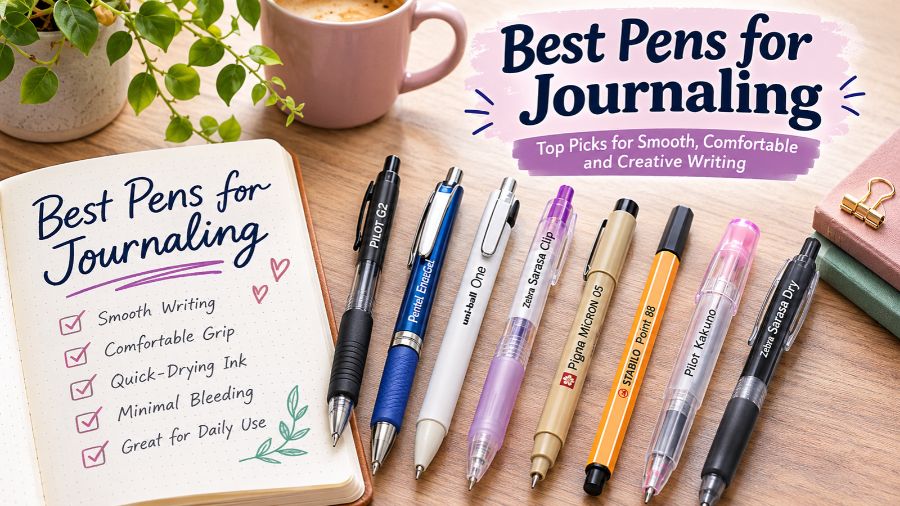
The market offers several types of journaling pens, ranging from affordable gel pens to specialist fineliners and beginner-friendly fountain pens. The following options are selected for different writing preferences rather than suggesting that one product is perfect for everyone. Their manufacturers provide different combinations of ink technology, tip sizes, colours, refill options, and writing characteristics, making them useful for different journaling activities.
1. Pilot G2 Gel Pen: Best for Everyday Journaling
The Pilot G2 is a popular retractable gel pen worth considering for everyday journaling, personal notes, and regular handwriting. Its gel-based ink provides a smooth writing experience and produces clear lines that work well for ordinary notebook entries. The product range includes different point sizes, allowing writers to select a finer or broader line according to their handwriting preferences. Its comfortable grip and retractable design also make it convenient for people who frequently open their journals throughout the day. Another useful feature is its refillable construction, which can reduce the need to replace the entire pen when the ink runs out. However, gel ink can require additional drying time on certain papers, so writers should check for smudging before using it extensively in their notebooks.
2. Pentel EnerGel RTX: Best for Quick-Drying Writing
The Pentel EnerGel RTX is an attractive option for people who prefer smooth handwriting but want to reduce the inconvenience of wet ink. It uses Pentel’s liquid gel ink technology, which is designed to provide quick-drying writing performance. This makes it particularly useful for left-handed writers who may accidentally drag their hands across freshly written lines. The RTX range includes different tip configurations, including fine and medium options, giving users flexibility when choosing their preferred writing style. Its comfortable grip can also make longer journaling sessions more manageable. The refillable design is another practical advantage for regular users. However, drying performance can vary depending on paper coating, ink colour, writing pressure, and environmental conditions, so testing it on the intended notebook remains important.
3. Uni-ball One: Best for Dark and Clear Handwriting
The Uni-ball One is a strong option for journal writers who appreciate dark, distinctive handwriting and a straightforward pen design. Its specially developed pigment-based gel ink is designed to produce vivid colours and maintain a clear appearance on paper. The manufacturer describes its ink as staying closer to the paper’s surface rather than being absorbed deeply into its fibres. This characteristic makes the pen particularly interesting for people who want readable journal entries and consistent-looking lines. The retractable construction also removes the inconvenience of managing a separate cap during everyday writing. Depending on the market and version, different point sizes and colour selections may be available. Nevertheless, writers should remember that ink performance depends on notebook paper, and no pen can guarantee completely invisible show-through on every journal.
4. Zebra Sarasa Clip: Best for Colourful Journaling
The Zebra Sarasa Clip is particularly suitable for creative journal layouts, colourful notes, and bullet journaling. It uses water-based pigment ink and is available in several colour collections, including vibrant, milky, and metallic finishes. Its retractable mechanism makes it convenient for everyday use, while the distinctive clip allows users to attach it to notebooks, folders, and other stationery items. Writers can use different colours to distinguish personal reflections, reminders, headings, and important events without changing their entire journaling routine. The 0.5 mm versions are especially worth considering for neat handwriting and detailed layouts. One limitation is that colour availability and specifications vary between product editions and markets. People who prefer a simple black-and-white journal may also find its colourful selection less necessary.
5. Sakura Pigma Micron: Best for Detailed Journaling and Illustrations
The Sakura Pigma Micron is a specialist fineliner designed for precise writing, illustration, and archival-quality projects. Its pigment-based Pigma ink is known for its permanent and fade-resistant properties, making it useful for people who want to preserve handwritten notes, drawings, and decorative journal elements. The range offers multiple point sizes, allowing users to create fine outlines, small details, and more prominent lettering. It is particularly useful for bullet journal designs, sketchbook entries, handwritten labels, and illustrations. Another important feature is its waterproof performance after the ink has dried, which makes it suitable for certain mixed-media applications. However, it is not necessarily the most economical choice for filling several pages with everyday writing, and its fineliner construction serves a different purpose from a conventional retractable gel pen.
6. STABILO Point 88: Best for Colour-Coded Journals
The STABILO Point 88 is a well-known fineliner that offers a practical combination of precision and colour variety. Its 0.4 mm line width makes it suitable for structured notes, decorative headings, small illustrations, and colour-coded journal layouts. The product range includes a wide selection of colours, including pastel and neon shades, giving creative users considerable flexibility. Its metal-encased tip is designed for durability and precise work with rulers and stencils. The pen is also useful for people who enjoy organizing weekly planners or highlighting different activities through handwritten colour systems. However, its water-based ink is not advertised as waterproof, and it may show through thinner paper depending on application. Writers should also remember to replace the cap after use, particularly when storing the pens for extended periods.
7. Pilot Kakuno: Best for Beginners Interested in Fountain Pens
The Pilot Kakuno is a beginner-friendly fountain pen worth exploring for people who want a traditional handwriting experience. Unlike gel pens and fineliners, fountain pens use liquid ink supplied through cartridges or compatible filling systems. The Kakuno has a lightweight design and approachable styling, making it an interesting choice for students and adults discovering fountain pen writing. Its nib options allow users to choose different line characteristics according to their handwriting preferences. Fountain pens can also offer a distinctive writing experience because ink selection influences colour, shading, and overall appearance. However, they require more attention than ordinary disposable pens. Users need to consider ink compatibility, cleaning, storage, and paper absorbency before choosing this option for regular journaling.
8. Zebra Sarasa Dry: Best for Writers Who Experience Smudging
The Zebra Sarasa Dry is another worthwhile option for people who prioritize quick-drying ink, particularly those who write rapidly or use their left hand. Its rapid-dry gel technology is designed to reduce smudging on commonly used writing surfaces. This characteristic can make it convenient for everyday journal entries, study notes, and handwritten planning. The range includes different product versions, with selected models offering comfortable grips and multiple ink colours. Writers who prefer a clean page without accidental hand marks may find it particularly useful. However, quick-drying performance should not be confused with universal resistance to bleeding or feathering. The final result still depends on the notebook’s paper quality, ink application, and writing conditions.
How to Choose the Best Pen for Your Journaling Style
Choosing a suitable pen becomes easier when you consider how you normally use your journal. Someone writing several pages of personal reflections may prioritize a comfortable grip and consistent ink flow, while a bullet journal enthusiast may need multiple colours and fine tips for creating structured layouts. People who frequently write with small handwriting should generally consider finer points, whereas those who prefer larger letters may find medium tips more comfortable. Left-handed writers should pay particular attention to drying performance because wet ink can transfer onto the opposite hand. Refillable construction may also be worth considering for people who regularly use the same pen. Ultimately, the best choice is one that matches your writing habits, notebook paper, preferred appearance, and budget.
Understanding Different Types of Journaling Pens
Understanding ink and pen categories can help shoppers avoid choosing a product simply because it looks attractive or has a popular brand name. Gel pens generally provide smooth, clearly visible lines and are available in numerous colours. Ballpoint pens usually use thicker, oil-based ink that can be practical for everyday writing and certain thin-paper notebooks. Fineliners are designed for precise lines and are particularly useful for illustrations, headings, and structured layouts. Rollerball pens typically use water-based liquid ink and can provide a fluid writing experience, although their behaviour varies between models. Fountain pens offer a traditional alternative with interchangeable inks and different nib characteristics. Each category has advantages, but their performance depends on the specific product and paper being used.
Gel Pens for Smooth Everyday Writing
Gel pens are among the most versatile options for people who regularly maintain personal journals. Their ink can produce strong, clearly visible lines, making handwritten entries easier to read. Many models also feature retractable mechanisms and comfortable grips that suit frequent use. However, gel ink formulations differ, meaning that drying times, water resistance, and ink flow are not identical across brands. People who write quickly should consider quick-drying models, while those using thin paper may benefit from testing finer tips.
Fineliners for Detailed Layouts and Creative Work
Fineliners are useful when journaling involves more than ordinary handwriting. Their narrow tips can create precise outlines, decorative borders, small illustrations, and structured headings. They are especially popular among people who maintain artistic bullet journals or combine written reflections with drawings. Pigment-based fineliners may also provide additional benefits when permanence and water resistance are important. However, some fineliners have firmer tips than ordinary gel pens, which may feel less comfortable for filling multiple pages with continuous writing.
Fountain Pens for Traditional Handwriting
Fountain pens offer a different experience because their nibs deliver liquid ink directly onto the paper. They appeal to people who enjoy experimenting with ink colours, handwriting styles, and traditional stationery. A suitable fountain pen can produce elegant handwritten entries, particularly when paired with compatible notebook paper. However, beginners should understand that fountain pens need regular maintenance and may behave differently depending on ink and paper combinations. They are therefore better suited to people who appreciate the additional care involved in using traditional writing instruments.
Why Paper Quality Matters When Selecting Journaling Pens
Paper quality is one of the most important factors influencing how a journaling pen performs. Bleeding occurs when ink passes through the paper and becomes visible on the opposite side, while ghosting refers to writing that can be seen faintly through the page without necessarily penetrating it. Feathering happens when ink spreads along paper fibres, making letters appear less precise. These problems can occur with different pen categories, depending on the notebook’s construction and the amount of ink applied. Paper thickness, surface coating, absorbency, and manufacturing quality all influence the final result. Writers using lightweight notebooks should consider finer tips and test different ink formulations before committing to a particular pen. Heavier paper may offer more flexibility, although it does not automatically guarantee perfect performance with every writing instrument.
Are Expensive Journaling Pens Better Than Budget Options?
Expensive pens are not automatically better for journaling because writing comfort and performance depend on individual preferences rather than price alone. An affordable gel pen may provide everything someone needs for daily reflections, while a premium fountain pen may offer additional enjoyment through its construction, nib, and ink compatibility. More expensive products may include metal bodies, improved finishing, replaceable components, or distinctive designs, but these features do not necessarily improve handwriting quality. Budget-conscious shoppers should focus on consistent ink flow, comfortable handling, suitable tip sizes, and refill availability. It is also sensible to consider the cost of replacement ink or refills when comparing products. A reasonably priced pen that works well with a preferred notebook can be a better long-term purchase than an expensive instrument that does not suit the writer’s habits.
Where to Buy Journaling Pens in the United States and United Kingdom
Shoppers in the United States and United Kingdom can find many popular journaling pens through stationery retailers, specialist writing stores, art supply shops, and online marketplaces. American shoppers can explore retailers such as Amazon, Target, Walmart, and specialist stationery stores, while UK buyers can consider Amazon UK, Cult Pens, WHSmith, and other established stationery retailers. Product availability, packaging, colours, and prices may differ between locations, so checking the exact model and tip size is important before purchasing. Buyers should also compare refill compatibility and shipping costs, particularly when ordering specialist Japanese stationery products. Purchasing from established retailers can make it easier to verify product descriptions and obtain genuine replacement components. Since retail prices and stock levels change frequently, checking current listings is more reliable than depending on older price comparisons.
Conclusion
Choosing the right journaling pen involves finding a balance between writing comfort, ink performance, paper compatibility, and personal preferences. The Pilot G2 and Uni-ball One are worth considering for everyday handwriting, while Pentel EnerGel RTX and Zebra Sarasa Dry offer useful options for people concerned about smudging. Sakura Pigma Micron and STABILO Point 88 are particularly suitable for detailed layouts, illustrations, and colourful journal designs, whereas Pilot Kakuno provides an introduction to traditional fountain pen writing. Ultimately, there is no single pen that works perfectly for every writer or notebook. Understanding the differences between ink types, tip sizes, and paper quality makes it easier to choose a reliable writing instrument that supports an enjoyable and consistent journaling routine.
FAQs
1. What is the best pen for journaling?
The Pilot G2 is a versatile everyday option, while Uni-ball One and Pentel EnerGel RTX offer alternatives for different ink preferences and writing requirements.
2. Are gel pens better than ballpoint pens for journaling?
Gel pens generally produce darker, smoother lines, while ballpoint pens can be practical on thinner paper and often require less drying time.
3. What pen is best for left-handed journaling?
Quick-drying options such as Pentel EnerGel RTX and Zebra Sarasa Dry can help reduce smudging for left-handed writers during everyday journaling.
4. Which journaling pens do not bleed through paper?
No pen guarantees zero bleeding on every notebook. Fine-tip pens and suitable paper combinations generally help reduce unwanted ink penetration and show-through.
5. What pen tip size is best for journaling?
A 0.5 mm tip suits many everyday writing styles, while 0.38 mm works well for smaller handwriting and detailed journal layouts.
6. Are fountain pens suitable for everyday journaling?
Yes, fountain pens can be excellent for daily journaling, provided users choose compatible paper and ink and maintain their writing instruments properly.
More read: Indicted Meaning