Spider Solitaire 2 Suit: Complete Rules, Gameplay, Strategies and Winning Tips
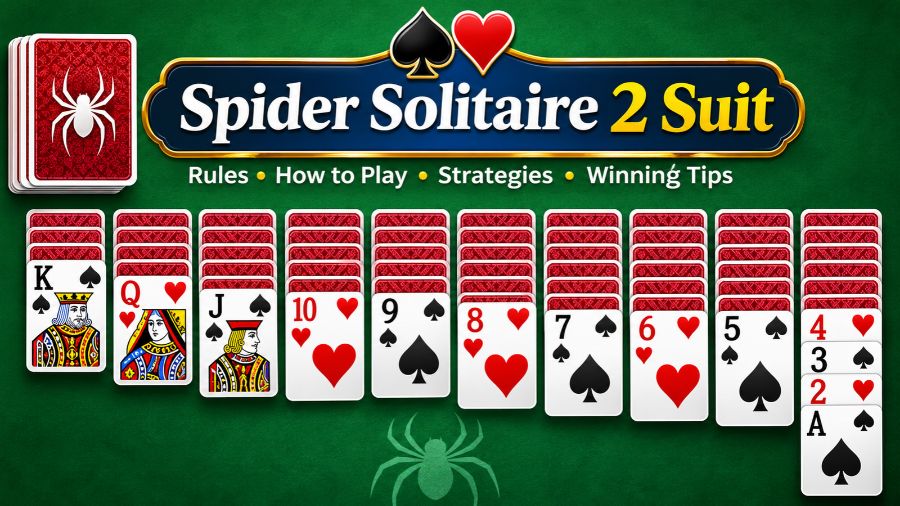
Spider Solitaire 2 Suit is a popular online card game that combines traditional solitaire gameplay with an extra level of strategy and difficulty. Played with two standard decks and two card suits, this version challenges players to organize cards into descending sequences, uncover hidden cards, and complete eight full sequences from King to Ace. It offers a balanced experience for people who enjoy card games, puzzles, and strategic thinking. Whether you are a beginner learning the rules or an experienced solitaire player looking to improve your performance, understanding the game’s setup, card movements, winning strategies, and available online platforms can make every session more enjoyable.
What Is Spider Solitaire 2 Suit?
Spider Solitaire 2 Suit is a variation of the traditional Spider Solitaire card game that uses two different suits instead of one or four. It normally uses Hearts and Spades, with two complete decks containing 104 cards altogether. The main objective is to arrange the cards into eight complete sequences, with each sequence following the order from King, Queen, Jack, and continuing down to Ace. Once a complete sequence of the same suit is created, it automatically disappears from the playing area. The two-suit format creates an interesting balance between accessibility and strategic complexity. Unlike the one-suit version, where every card belongs to the same suit, players must pay attention to both card rankings and suit combinations. This makes the game suitable for people who already understand basic solitaire rules and want a more challenging experience without moving directly to the four-suit version.
How Spider Solitaire 2 Suit Works
The game begins with a playing area containing ten columns of cards, with some cards facing downward and one visible card at the top of each column. The remaining cards form a stockpile that players can use when they need additional cards. The first four columns generally contain six cards each, while the remaining six columns contain five cards each, giving the initial tableau 54 cards. The other 50 cards stay in the stockpile and are distributed in five groups of ten. During gameplay, players move visible cards between columns to create descending sequences. A card can be placed on another card that has a value one rank higher, regardless of its suit. However, moving an entire group of cards requires the cards within that group to form a correctly ordered sequence of the same suit. This distinction is central to the game’s strategy because mixed-suit sequences can be created but cannot be moved together as a complete group.
Understanding the Main Rules of Spider Solitaire 2 Suit
Learning the basic rules is important before attempting advanced strategies. The primary objective is to remove every card from the playing area by completing eight same-suit sequences, each beginning with a King and ending with an Ace. Players can move individual face-up cards onto cards that are one rank higher, even when the suits are different. For example, a Six of Hearts can be placed on a Seven of Spades. However, a sequence containing cards of different suits cannot be moved together as one complete unit. Empty columns can hold any available card or a valid sequence, making them valuable spaces for reorganizing the tableau. Players can also use the stockpile to distribute additional cards across all ten columns, but most versions require every column to contain at least one card before another deal is allowed. Completed sequences are automatically removed, and the game ends successfully when all eight sequences have been cleared.
Understanding Card Sequences
Card sequences are the foundation of Spider Solitaire 2 Suit. Players must arrange cards in descending numerical order, starting with King, followed by Queen, Jack, Ten, Nine, Eight, Seven, Six, Five, Four, Three, Two, and Ace. The objective is not simply to create descending arrangements but to build complete sequences using matching suits. For example, a King, Queen, Jack, and Ten of Hearts can form part of a valid Hearts sequence. Players should prioritize connecting cards of the same suit because these groups can be moved together, allowing greater flexibility when reorganizing the columns. Creating mixed-suit sequences may help uncover hidden cards temporarily, but they can make future moves more complicated.
Using the Stockpile Correctly
The stockpile provides additional cards when the existing columns no longer offer useful moves. Selecting the stockpile generally places one new face-up card on each of the ten columns. These additional cards can create new opportunities, but they can also cover useful sequences and make existing arrangements harder to manage. Players should therefore explore available moves before dealing another row. Clearing unnecessary obstructions, uncovering hidden cards, and organizing matching suits can improve the position of the tableau before new cards arrive. It is also important to remember that standard versions generally prevent another stockpile deal when one or more columns are empty.
Best Strategies to Win Spider Solitaire 2 Suit
Winning consistently requires more than finding cards that fit together. Players need to consider how each move affects hidden cards, empty columns, and future sequences. One of the most useful strategies is to uncover face-down cards as early as possible because hidden cards may contain important ranks needed to complete existing sequences. Building same-suit groups should also receive priority because these sequences can be transferred between columns as a unit. Empty columns are particularly valuable because they allow players to temporarily store cards and reorganize complicated arrangements. Another effective approach is to avoid making unnecessary moves simply because they are available. A move that creates a longer mixed-suit sequence might look helpful initially but could restrict future movement. Experienced players generally evaluate several possible moves before choosing one, especially when deciding whether to move a card away from a partially completed same-suit sequence.
Prioritize Hidden Cards
Uncovering hidden cards is one of the most important parts of a successful game. Every face-down card represents information that is unavailable until the card above it is moved. By revealing these cards, players gain additional options and may discover ranks needed to complete important sequences. When choosing between two possible moves, consider which one will uncover a hidden card or create a more useful column arrangement. This approach is generally more productive than making moves that only rearrange visible cards without improving the overall position.
Make Good Use of Empty Columns
An empty column provides temporary storage and makes it easier to organize the tableau. Unlike some other solitaire variations, Spider Solitaire allows players to place any eligible card or valid sequence into an empty space rather than requiring a King. This flexibility can help separate mixed-suit arrangements, uncover hidden cards, and bring matching sequences together. However, players should avoid filling empty columns without considering their next moves. An empty space can be more valuable than a temporary arrangement that does not contribute toward completing a same-suit sequence.
Avoid Unnecessary Stockpile Deals
Dealing additional cards too early can make a manageable game more difficult. New cards are placed on top of existing columns, potentially covering sequences that players were preparing to move. Before using the stockpile, examine every column and identify whether any useful card movements remain. Try to uncover hidden cards and improve same-suit sequences first. This does not mean that players should avoid the stockpile entirely, because additional cards are necessary to complete most games. Instead, the goal is to use each deal when it offers the greatest practical benefit.
Spider Solitaire 2 Suit vs One Suit and Four Suits
Spider Solitaire is commonly available in three difficulty levels: one suit, two suits, and four suits. The one-suit version is generally the easiest because every card belongs to the same suit, allowing players to move descending sequences together without worrying about suit differences. The two-suit version introduces additional complexity by requiring players to manage two separate suits and distinguish between movable same-suit groups and mixed-suit arrangements. Four-suit Spider Solitaire is typically the most challenging because players must coordinate Hearts, Diamonds, Clubs, and Spades while building multiple sequences. The two-suit version sits between these alternatives and provides a useful progression for players who have become comfortable with simpler games. Choosing the right version depends on individual experience, preferred difficulty, and how much strategic planning a player wants from each session.
Benefits of Playing Spider Solitaire 2 Suit
Spider Solitaire 2 Suit offers several appealing qualities beyond simple entertainment. The game encourages players to evaluate different possibilities, recognize card patterns, and plan sequences before committing to a move. These activities involve attention, organization, and decision-making, making the game an engaging mental challenge. It can also provide a convenient recreational activity because most browser-based versions can be played without downloading dedicated software. Another advantage is its flexible difficulty level. Beginners familiar with basic solitaire can learn the two-suit rules gradually, while experienced players can use advanced strategies to improve their results. The game also supports independent play, meaning there is no requirement to coordinate with other players or follow a multiplayer schedule. However, it should primarily be viewed as entertainment rather than a guaranteed method of improving memory or preventing cognitive decline.
Where to Play Spider Solitaire 2 Suit Online
Several gaming websites provide browser-based versions of Spider Solitaire 2 Suit, allowing players to start a game without installing a desktop application. Arkadium is one recognizable option that offers a dedicated two-suit version with gameplay instructions and features such as hints and undo options. TrySolitaire is another option for people interested in browser-based solitaire games, while Solitaire Owl and other independent gaming websites may also provide two-suit variations. The available features, advertisements, account requirements, and mobile compatibility can differ between platforms. Before choosing a website, players should check whether it offers the preferred difficulty level, whether the game works properly on their device, and whether additional features require registration. Using a browser-based version from a recognizable provider can make it easier to access the game on different devices.
Common Mistakes to Avoid During Gameplay
Many players struggle with Spider Solitaire 2 Suit because they focus on immediate card movements rather than the overall arrangement. One common mistake is creating long mixed-suit sequences without considering how difficult they may become to separate later. Another is filling empty columns too quickly, leaving no useful space for reorganizing cards. Dealing from the stockpile before exploring available moves can also cover important cards and reduce flexibility. Some beginners move cards simply because they can, without considering whether the movement reveals a hidden card or helps complete a same-suit sequence. Players may also overlook the importance of planning around Kings, Queens, and other high-ranking cards because these ranks influence how complete sequences can be assembled. Avoiding these mistakes requires patience, careful observation, and an understanding of how individual moves affect the entire tableau.
Is Spider Solitaire 2 Suit Suitable for Beginners?
Spider Solitaire 2 Suit can be suitable for beginners who already understand basic card rankings and have some familiarity with solitaire. However, someone completely new to card games may find the one-suit version easier as an introduction. The two-suit format requires players to understand both descending order and suit matching, which adds another layer of decision-making. A useful learning approach is to begin by identifying valid card movements, then practice creating same-suit sequences and uncovering hidden cards. Players can also use available hint and undo features when learning a particular platform’s rules. With practice, it becomes easier to recognize useful arrangements and understand why certain moves create better opportunities than others. Beginners should focus on completing games and learning the mechanics before worrying about speed or high scores.
Conclusion
Spider Solitaire 2 Suit offers an enjoyable combination of traditional card gameplay, strategic planning, and moderate difficulty. Its two-suit format creates a meaningful challenge by requiring players to build descending sequences while keeping track of suit combinations and available movements. Understanding the ten-column layout, using empty spaces effectively, uncovering hidden cards, and managing the stockpile are all important parts of successful gameplay. Compared with one-suit and four-suit variations, it provides a balanced experience for players seeking something more challenging than basic solitaire without the complexity of managing four suits. Whether played casually or as a strategic card puzzle, Spider Solitaire 2 Suit remains an accessible option for people who enjoy thoughtful and independent online games.
FAQs
1. Is Spider Solitaire 2 Suit free to play?
Yes, several websites offer free browser-based versions of Spider Solitaire 2 Suit, although advertisements, optional features, and registration requirements vary between platforms.
2. How many cards are used in Spider Solitaire 2 Suit?
The game uses 104 cards from two standard decks, featuring two suits, with 54 cards initially dealt into ten columns and 50 remaining in the stockpile.
3. How do you win Spider Solitaire 2 Suit?
You win by completing eight same-suit sequences, arranging every card from King down to Ace, and removing all completed sequences from the playing area.
4. What is the difference between one-suit and two-suit Spider Solitaire?
One-suit Spider Solitaire uses a single suit, while two-suit gameplay introduces another suit, requiring additional planning to organize and move complete sequences.
5. Can you play Spider Solitaire 2 Suit on mobile devices?
Yes, many browser-based versions support smartphones and tablets, allowing players to enjoy the game through compatible mobile browsers without installing desktop software.
6. Is Spider Solitaire 2 Suit harder than regular Solitaire?
It is generally more challenging than basic Klondike Solitaire because it uses two decks, ten columns, and suit-dependent sequences that require careful planning.
More read: WhenToMeet