W2W Meaning: What Does It Stand For? A Complete Guide to Its Uses
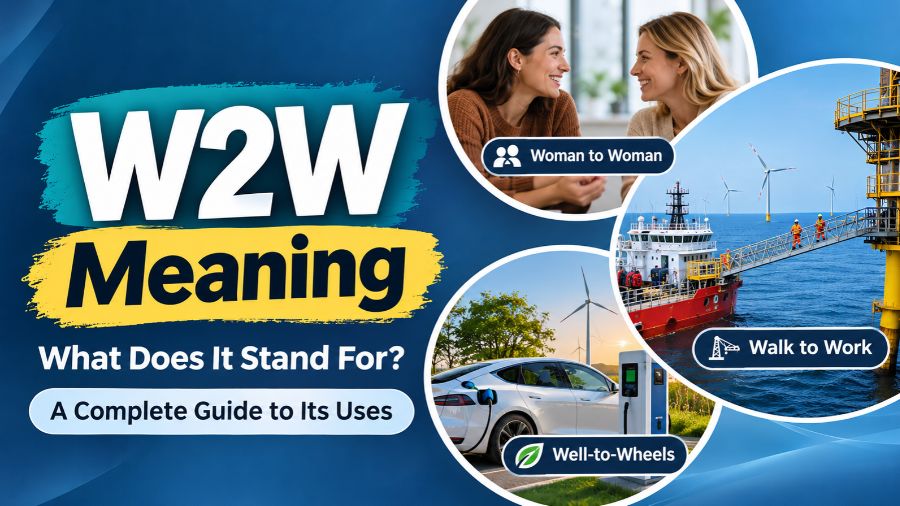
W2W is an abbreviation with several meanings across everyday communication, business, engineering, technology, and environmental research. Because the number 2 is commonly used as a replacement for the word “to,” W2W can represent expressions such as Woman to Woman, Walk to Work, and Well to Wheel. Understanding its meaning requires looking at the context in which it appears, whether in a text message, professional conversation, technical document, or industry publication. This guide explores the most relevant interpretations of W2W, explains how the abbreviation is used in different fields, and helps readers identify the meaning that best fits their situation.
What Does W2W Stand For?
W2W does not have one universally accepted full form. It is a context-dependent abbreviation, meaning that its interpretation changes according to the subject, industry, or conversation. In informal communication, it can represent Woman to Woman, describing an honest exchange between two women. In offshore engineering, W2W commonly means Walk to Work, referring to a specialized method of transferring personnel from a vessel to an offshore installation. In environmental and automotive research, a closely related abbreviation, WtW or WTW, stands for Well-to-Wheels. Although these expressions look similar, they should not automatically be treated as interchangeable. Identifying the surrounding subject is the most reliable way to understand what someone means by W2W.
The Most Common Meanings of W2W
W2W appears in several different contexts, but some interpretations have clearer and more established uses than others. Woman to Woman is associated with personal communication and women’s communities, while Walk to Work is a recognized offshore industry term. Other expressions, including Wall to Wall and Waste to Wealth, may appear in particular business or organizational settings, but their meanings are not universal abbreviations. This distinction matters because an abbreviation used by one company or community may have a completely different meaning elsewhere. Readers should consider the document, conversation, or industry in which W2W appears before choosing a definition.
Woman to Woman
Woman to Woman describes direct, honest communication between two women. The expression often refers to conversations involving personal experiences, advice, encouragement, relationships, professional challenges, or mutual understanding. It can also describe communities and initiatives that connect women with mentors and professional opportunities. In everyday conversations, someone might say they want to have a woman-to-woman discussion to communicate openly and comfortably. Organizations may use Women2Women or W2W as part of their branding for mentorship, leadership development, networking, and community-building programs. In this context, the abbreviation represents a relationship or communication approach rather than a technical process.
Walk to Work
Walk to Work is one of the most clearly established technical meanings of W2W. It is particularly relevant to offshore oil and gas operations and the offshore wind industry. The expression describes arrangements that allow workers to move between an offshore support vessel and an installation using a specialized access gangway. These vessels can provide accommodation, facilities, and transportation for personnel working on offshore platforms or renewable energy installations. The system helps operators organize personnel transfers and support maintenance activities without depending entirely on helicopter transportation. Safety, vessel positioning, gangway performance, and operational planning are important parts of the process.
Well-to-Wheels
Well-to-Wheels is a recognized environmental and automotive research term, although its usual abbreviations are WtW and WTW rather than W2W. It describes the energy consumption and emissions associated with producing and supplying fuel or electricity and using that energy to operate a vehicle. Researchers use this approach to compare different energy pathways, including petrol, diesel, natural gas, hydrogen, and electricity. The analysis considers both upstream activities, such as energy production and distribution, and downstream activities involving vehicle operation. It is particularly important when evaluating whether an alternative fuel or electric vehicle offers environmental advantages across the energy supply chain.
How W2W Is Used in Different Industries
The meaning of W2W becomes easier to identify when it is connected to a particular professional or social environment. In personal communication, the expression may describe supportive conversations between women. In offshore engineering, it refers to physical access arrangements between vessels and installations. In environmental research, readers may encounter the similar-looking WtW abbreviation when studying transportation emissions. Businesses can also create their own W2W programs, internal project names, or branded initiatives. Therefore, recognizing the industry and the surrounding terminology is more useful than relying on the abbreviation alone.
W2W in Social Media and Text Messages
On social media and messaging platforms, W2W may be used as shorthand for Woman to Woman, particularly when discussing personal experiences, relationships, advice, or women’s issues. For example, a person might use the expression when introducing an honest conversation or sharing a supportive message with another woman. However, W2W is not a universally understood texting abbreviation, so its meaning should not be assumed without context. If someone uses it in a message about offshore operations, workplace transportation, or environmental research, the intended interpretation could be entirely different.
W2W in Business and Professional Communication
In professional environments, W2W may describe networking programs, mentorship initiatives, employee communities, or projects designed to connect women in the workplace. Some organizations use Women2Women branding to encourage professional development and leadership opportunities. Other businesses may use the same letters for internal programs or operational terminology. In these situations, the full form is usually established by the organization itself. Employees should check company documentation or ask the person using the abbreviation rather than assuming that every business uses W2W in the same way.
W2W in Offshore Engineering and Renewable Energy
Offshore engineering provides one of the strongest examples of W2W as an established technical expression. Offshore wind farms and oil and gas installations often operate far from shore, making personnel transportation an important operational consideration. A Walk to Work vessel can remain near an offshore installation and use a motion-compensated gangway to provide access for workers. These systems are designed to accommodate vessel movement and help maintain a controlled connection during personnel transfers. The UK offshore safety regulator recognizes W2W operations as activities requiring appropriate risk management, equipment approval, competent personnel, and emergency arrangements.
W2W in Automotive and Environmental Research
Automotive environmental studies frequently use Well-to-Wheels analysis to evaluate the broader environmental effects of transportation energy. This approach is useful because a vehicle’s environmental impact does not begin only when its engine starts or its electric motor operates. Producing petrol, refining diesel, generating electricity, and transporting energy all involve different processes and potential emissions. By examining the complete fuel or energy pathway, researchers can make more meaningful comparisons between vehicle technologies. Readers should remember that the established abbreviation is generally WtW or WTW, not necessarily W2W.
How Walk-to-Work Technology Operates
A Walk to Work arrangement involves a support vessel, a specialized access system, and an offshore installation. The vessel positions itself close to the installation while maintaining a suitable distance and orientation for safe personnel transfer. A motion-compensated gangway then provides a connection between the two structures. Depending on the system, sensors and control mechanisms help compensate for relative movement caused by waves and vessel motion. Workers use the gangway to reach the installation and perform assigned duties. The operation requires coordination between vessel operators, offshore personnel, and those responsible for the access equipment. Its effectiveness depends on suitable weather conditions, equipment performance, established procedures, and emergency preparedness.
The Role of Motion-Compensated Gangways
A motion-compensated gangway is a specialized access bridge designed to accommodate relative movement between an offshore vessel and an installation. Unlike an ordinary fixed walkway, it uses engineering and control systems to respond to vessel movement and maintain a usable connection within its approved operating limits. This helps workers transfer between the two structures without relying on conventional ladder-based access arrangements. The gangway must be appropriately designed, maintained, tested, and operated by competent personnel. Its performance is a major consideration when selecting a Walk to Work vessel for a particular offshore project.
Safety Considerations During Personnel Transfers
Safety is essential because offshore environments involve changing weather, sea conditions, and equipment movement. Operators must evaluate the condition of the vessel, the gangway, the installation, and the surrounding environment before allowing personnel transfers. Emergency procedures must also address situations such as equipment failure, unexpected vessel movement, or the need to evacuate workers. Appropriate training, communication, maintenance, certification, and operational limits help reduce potential hazards. A Walk to Work system should never be considered automatically safe simply because it uses advanced technology; its safety depends on proper management and compliance with applicable requirements.
Benefits and Limitations of W2W Systems
Walk to Work systems can provide practical benefits for offshore operators by supporting personnel transportation, accommodation, and maintenance activities. They can reduce dependence on repeated helicopter journeys and help accommodate additional workers during maintenance campaigns. A support vessel may also provide facilities for personnel who need to remain offshore for extended periods. However, these systems require specialist vessels, trained crews, certified access equipment, and careful operational planning. Weather conditions and sea movement can restrict transfers, while vessel availability and operating costs may influence project decisions. Consequently, W2W is not a universal replacement for helicopters or other offshore transportation methods; operators must assess the most appropriate solution for each project.
W2W vs WTW: Understanding the Difference
W2W and WTW can look similar when written quickly, but their meanings may be very different. W2W is an established abbreviation for Walk to Work in offshore operations, while WTW or WtW commonly represents Well-to-Wheels in transportation research. The first concerns the movement of personnel between vessels and offshore installations. The second concerns the energy supply chain and the environmental effects of operating vehicles. Woman to Woman is another possible interpretation of W2W in social and professional communication. Correctly distinguishing these terms is important when reading technical reports, industry documents, online discussions, and workplace communications.
How to Identify the Correct Meaning of W2W
The easiest way to understand W2W is to examine the words and subject surrounding it. If the discussion includes offshore vessels, gangways, wind farms, platforms, or personnel transfers, Walk to Work is probably intended. If it involves women’s leadership, mentoring, relationships, or personal discussions, Woman to Woman is a more likely interpretation. If the subject concerns fuel production, electric vehicles, greenhouse gas emissions, or energy efficiency, check whether the writer actually means WTW or WtW. Company documents may also define W2W as an internal abbreviation. When the surrounding information does not provide enough detail, asking the author for clarification is better than relying on an uncertain interpretation.
The Future Relevance of W2W
The relevance of W2W depends on the industry using it. Offshore Walk to Work systems are likely to remain important wherever offshore operators need organized personnel access for maintenance, construction, and other activities. As offshore wind projects and marine infrastructure develop, vessel access arrangements, gangway engineering, and operational safety will continue to receive attention. Meanwhile, Woman to Woman initiatives can remain relevant to professional networking, mentorship, and community development. Environmental researchers will continue using Well-to-Wheels methodologies, although the established terminology remains WTW or WtW. These developments demonstrate why the abbreviation should always be interpreted according to its specific subject rather than treated as one fixed concept.
Conclusion
W2W is a context-dependent abbreviation with several possible interpretations, including Woman to Woman and Walk to Work. Its technical use is particularly important in offshore engineering, where specialized vessels and gangways support personnel transfers to offshore installations. In automotive research, the similar abbreviation WTW or WtW refers to Well-to-Wheels analysis and should be distinguished from W2W. Understanding the surrounding subject, terminology, and industry makes it easier to identify the correct meaning. Ultimately, W2W is best understood as an abbreviation whose significance depends on how and where it is used.
FAQs
1. What is the full form of W2W?
W2W can stand for Woman to Woman or Walk to Work, depending on context. It does not have one universally accepted full form.
2. What does W2W mean in texting?
In texting, W2W may mean Woman to Woman, describing an honest conversation, personal advice, or communication between two women.
3. What does W2W mean in offshore engineering?
In offshore engineering, W2W means Walk to Work, a personnel transfer arrangement using specialized vessels and gangways to access offshore installations.
4. Is W2W the same as WTW?
No. W2W commonly means Walk to Work, while WTW or WtW generally means Well-to-Wheels in automotive and environmental research.
5. What is a Walk to Work vessel?
A Walk to Work vessel is a specialized offshore support ship equipped with accommodation facilities and access systems for transferring personnel safely.
6. Why is W2W important in renewable energy?
W2W supports offshore wind farm operations by helping workers access installations for maintenance, inspections, construction activities, and other essential operational tasks.
More read: Edesign