Trastullami: Meaning, Fabric Uses, Features and Creative Ideas
What Is Trastullami?
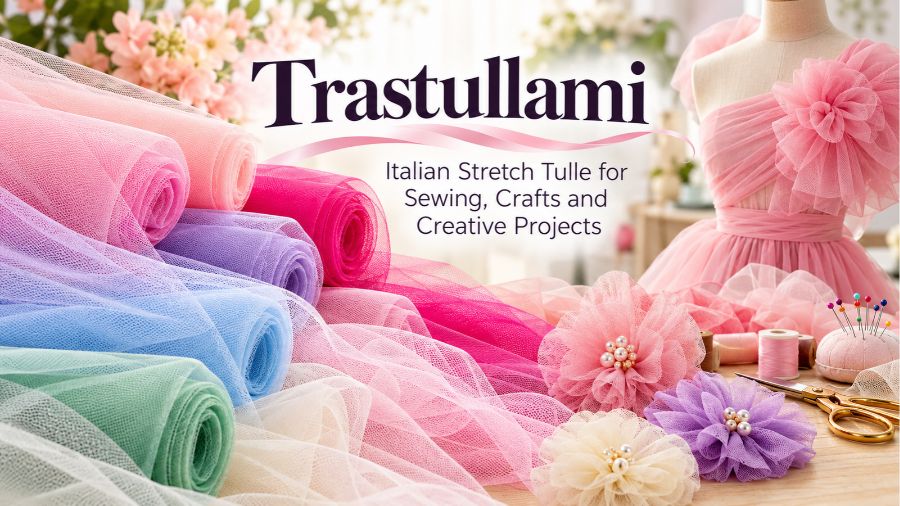
Trastullami is a textile product associated with stretch tulle, a lightweight fabric with an open, net-like structure and elastic properties. Italian textile retailers describe it as suitable for both decorative applications and dressmaking. Unlike a rigid tulle material, stretch tulle can accommodate movement and can be gathered, layered, or shaped for particular designs. Its usefulness depends on the construction of the fabric and the requirements of the finished project. Although the name is associated with a specific product, buyers should distinguish Trastullami from stretch tulle as a general fabric category because not all elastic tulle products have identical characteristics.
The meaning of Trastullami depends on the context in which it appears. In textile listings, it refers to a stretch-tulle product associated with I Nastri di Mirta. In an Italian-language context, the spelling resembles a form connected with trastullare, a verb associated with amusing or entertaining someone, and trastullarsi, which can mean amusing oneself, playing, or passing time. These linguistic associations should not automatically be treated as the confirmed origin of the fabric’s product name. When researching the term, readers should use the surrounding sentence or product description to determine whether the subject is Italian vocabulary or a textile material.
Trastullami and I Nastri di Mirta
I Nastri di Mirta is associated with a range of textile products, including ribbons, lace, trims, and fabrics. Its corporate history describes the development of the business from an earlier family enterprise into a producer and distributor of textile accessories and creative materials. Retail listings specifically identify Trastullami as a product associated with the brand and describe its use in dressmaking and decoration. This association helps shoppers distinguish the named product from generic stretch tulle, although current availability, dimensions, colors, and selling conditions should always be checked with the individual retailer.
Stretch and Flexibility
The stretch characteristic is an important reason to consider this type of tulle for suitable sewing and decorative applications. Elastic fabric can accommodate movement and may be easier to gather or arrange around curved shapes than a comparable rigid material. However, stretch direction, elasticity, and recovery vary between textiles, so buyers should not assume that every product behaves identically. Before using Trastullami in a fitted garment or a project requiring precise measurements, check the product description and, when possible, test a small sample to understand how the fabric responds to tension and handling.
Lightweight, Airy Appearance
Tulle is recognized for its open, net-like construction, which creates a lightweight visual effect. This structure can add volume, texture, and layered detail without necessarily producing the appearance of a heavy woven fabric. In decorative projects, it can help create soft shapes and translucent overlays. The final result depends on the density, drape, color, and construction of the material. For applications requiring a specific level of coverage or opacity, a sample is more reliable than judging the fabric solely by its name or a photograph.
Color and Design Possibilities
Color selection can influence how stretch tulle works in clothing and craft projects. Neutral shades may suit understated accessories and layered garments, while bright or contrasting colors can create more noticeable decorative effects. An Italian retailer’s Trastullami listing displays multiple color options, although the available shades can change as stock and product selections change. Buyers planning coordinated projects should verify the precise color and availability before ordering, particularly when matching fabric with thread, lace, ribbons, or other materials.
What Is Trastullami Used For?
Trastullami can be considered for creative sewing, dressmaking, and decorative applications where a lightweight, elastic tulle is suitable. Potential projects include costume details, clothing accents, fabric flowers, hair accessories, brooches, and handmade decorations. The fabric’s open structure and flexibility may be useful when creating gathered or layered shapes. Nevertheless, suitability depends on the design, the material’s verified specifications, and the way the finished item will be used. A project that requires strong support, substantial opacity, or high resistance to wear may need a different fabric or additional structural materials.
Dressmaking and Clothing Details
In dressmaking, stretch tulle can be used for selected overlays, decorative panels, gathered details, and costume elements. Its flexibility can be useful in designs that need to move with the wearer, although the material should be evaluated for comfort, transparency, and durability. For fitted garments, seams and edges may need careful handling to prevent unwanted distortion. The best approach is to confirm the fabric’s stretch and recovery, consider the garment’s construction, and test stitching techniques on a small piece before beginning the final item.
Fabric Flowers and Handmade Accessories
Stretch tulle can be shaped into decorative flowers by arranging, folding, gathering, and securing layers of material. Finished flowers may be incorporated into hair accessories, brooches, bags, or clothing decorations, depending on the project’s design. Smaller pieces can also be useful for experimenting with bows, soft embellishments, and other handmade details. The finished appearance will depend on the number of layers, the method of assembly, and the fabric’s ability to hold its shape. Testing a small sample first can help determine how much material and gathering are needed.
Decorations and Creative Projects
Lightweight tulle may also be suitable for selected event decorations, craft displays, and decorative accents. Its airy appearance can add texture without making an arrangement visually heavy, while its flexibility allows it to be folded or gathered into different shapes. However, the material should not be assumed suitable for every installation or environment. Projects exposed to heat, moisture, frequent handling, or outdoor conditions may require different materials. For any decoration involving candles, electrical equipment, or other heat sources, keep fabric away from potential ignition sources and follow appropriate safety precautions.
Trastullami vs. Regular Tulle
Trastullami and regular tulle should not be treated as interchangeable terms. Tulle is a broad category of lightweight, net-like textiles that can differ in fiber composition, structure, stiffness, transparency, and elasticity. Trastullami, by contrast, is a specific product name associated with stretch tulle. This distinction matters when shopping because a generic tulle fabric may not provide the same flexibility or handling characteristics as the named product. Buyers should compare the actual product specifications rather than relying on labels alone. The appropriate choice depends on whether the project requires elasticity, a firmer structure, a particular drape, or a specific decorative effect.
How to Choose the Right Trastullami Fabric
Selecting the right textile starts with understanding the finished project’s requirements. Before purchasing Trastullami, consider the required dimensions, intended application, color, elasticity, transparency, and method of construction. A material suitable for a small decorative flower may not necessarily be the best choice for a fitted costume or a large garment panel. Reading the seller’s description carefully can prevent misunderstandings about what is being sold. When specifications are incomplete, asking the retailer for clarification or requesting a sample can provide a better basis for a purchasing decision.
Check Width and Length
Fabric measurements are particularly important when calculating how much material a project requires. One Italian retailer lists Trastullami with a width of 145 centimetres and sells it by measured length, while another describes its product in 15-centimetre increments. These are examples of individual retail arrangements, not universal specifications for every seller. Confirm the width, minimum order quantity, cutting increments, and whether multiple quantities will arrive as one continuous piece. This is especially important when creating garments, long decorative panels, or projects that require uninterrupted fabric.
Fiber composition influences how a fabric feels, stretches, recovers, and responds to care. A product description may identify a textile as elastic tulle, but that description alone does not establish its precise fiber content or stretch performance. Check the manufacturer’s or seller’s specifications before assuming the material contains nylon, polyester, elastane, or any particular blend. If the project involves close-fitting clothing, test the fabric under gentle tension and observe whether it returns to its original shape. For important projects, a sample test can help assess sewing performance and reduce the risk of wasting material.
Evaluate Color and Transparency
Color and transparency can significantly affect the final result, particularly when the fabric will be layered over another textile or used for a decorative accessory. A shade displayed on a screen may look different under natural light, indoor lighting, or alongside other materials. Where color matching is essential, compare a physical sample with the other fabrics in the project. Transparency should also be checked against the intended background or lining. These precautions help ensure that the finished garment or decoration has the desired appearance rather than relying entirely on product photographs.
Read the Retailer’s Selling Conditions
Retailers may use different measurement units, minimum order quantities, prices, and stock arrangements. Some sell fabric in measured lengths, while others use predetermined increments or cuts. Shipping conditions, return policies, and the treatment of cut-to-order materials can also vary. Before placing an order, make sure the displayed price corresponds to the quantity you intend to purchase. Confirm whether multiple increments are supplied in one continuous piece and whether the required color is currently available. Checking these details can prevent unexpected costs and misunderstandings after the order has been placed.
How to Sew With Stretch Tulle
Working with stretch tulle requires attention to the material’s flexibility and delicate structure. The appropriate sewing technique depends on the fabric’s construction, the garment design, and the equipment available. A small test piece is a useful starting point because it reveals whether the chosen needle, thread, stitch length, and machine settings produce a satisfactory seam. Avoid pulling the material unnecessarily while sewing, as excessive tension can distort the finished edge. For fitted designs, use a seam construction that accommodates the fabric’s stretch, and follow a suitable pattern or garment-making guide when the project requires more advanced techniques.
Prepare the Fabric Before Cutting
Before cutting, inspect the fabric for damage and identify the direction in which it stretches. Lay it on a clean, flat surface and use suitable weights or gentle pinning to prevent movement. Sharp fabric scissors or a rotary cutter, used on an appropriate cutting surface, can help produce cleaner edges. Because stretch materials can shift during cutting, avoid stretching the fabric to make it fit a pattern piece. Accurate preparation is particularly useful for symmetrical accessories, repeated decorative elements, and clothing panels that need to match in size.
Test Stitching and Seam Finishes
The best stitch depends on the fabric’s elasticity and the purpose of the finished item. A stitch that works on a stable woven fabric may restrict movement or produce puckering on a stretch textile. Test the seam on a spare piece and gently stretch it to see whether the stitches remain intact. If the edge curls or distorts, adjust the technique before continuing. Lightweight net fabrics can also require careful handling around seams and attachments. The aim is to create a secure finish without unnecessarily flattening, tearing, or stretching the material.
Handle the Fabric Carefully
Stretch tulle can be delicate, depending on its fiber and construction. Avoid catching the netting on rough surfaces, sharp accessories, or damaged sewing equipment. Store unused fabric in a clean, dry place and keep it away from objects that could snag the open structure. During assembly, handle the material gently and avoid pulling gathered sections too tightly. These basic precautions can help preserve the fabric’s appearance, although the best handling and care methods should always be guided by the specific product’s instructions.
How to Care for Trastullami
Care instructions should be based on the fabric’s actual fiber composition and the manufacturer’s recommendations. The name Trastullami alone does not establish a universal washing temperature, drying method, or ironing setting. Before cleaning a finished item, consult the product information and consider testing an inconspicuous area if the instructions permit. Some textiles can be damaged by excessive heat, aggressive washing, or rough handling, particularly when their structure is lightweight and elastic. If the material is incorporated into an embellished garment, the care requirements of the other components must also be considered.
Washing and Drying
Do not assume that all stretch tulle can be machine-washed or tumble-dried. Check whether the fabric is washable and whether handwashing or a particular washing cycle is recommended. If washing is permitted, handle the material gently to reduce the risk of snagging, stretching, or damaging decorative attachments. Avoid harsh treatment unless the product’s care instructions explicitly allow it. Dry the material according to the manufacturer’s guidance rather than applying high heat automatically. If the fabric forms part of a costume or accessory with multiple components, consider how each component will respond to moisture.
Storage and Wrinkle Prevention
Proper storage can help protect lightweight fabric from unnecessary damage. Keep the material clean and dry, avoid placing heavy objects on delicate decorative pieces, and store finished accessories where they will not become crushed or tangled. If wrinkles appear, consult the fabric’s care instructions before using an iron or steamer. High temperatures may damage some synthetic fibers or affect elastic properties. For finished garments, follow the care label rather than relying on a general recommendation for tulle. Gentle handling is particularly important when the fabric has been gathered or shaped into three-dimensional decorations.
Advantages and Limitations of Trastullami
Trastullami’s association with stretch tulle makes it a potential option for projects that benefit from flexibility, a lightweight appearance, and decorative layering. It may be useful for creative sewing, selected clothing details, and handmade accessories. Its limitations, however, depend on the precise product and application. Lightweight netting may not provide the structure, opacity, abrasion resistance, or support required for every project. Elasticity can also make cutting and sewing more demanding than working with a stable fabric. Understanding these trade-offs helps buyers choose materials according to practical requirements instead of relying on a product name alone.
Potential Benefits
For suitable applications, stretch tulle can offer flexibility, an airy appearance, and opportunities for creating layered or gathered designs. Its open structure can add visual texture without the heavier look of many solid fabrics. The material may also be adapted to different colors and decorative styles, depending on the retailer’s range. These characteristics make it worth considering for selected costumes, embellishments, accessories, and craft projects. The actual benefit will depend on the fabric’s construction and how well its properties match the intended design.
Potential Limitations
A lightweight elastic textile may be unsuitable when a project requires firm support, complete coverage, or exceptional durability. Its open structure can leave the underlying material visible, while its stretch may complicate pattern cutting or seam construction. Delicate netting can also snag, and its care requirements may limit how a finished item can be cleaned. These are general considerations for stretch-tulle fabrics, not proof that every Trastullami product has the same weaknesses. Checking the specific product information and testing a sample can help identify limitations before committing to a larger project.
Where Can You Buy Trastullami?
Trastullami appears in Italian online fabric and haberdashery listings. For example, Linea Merceria describes a Trastullami product associated with I Nastri di Mirta, while C’era una stoffa lists a stretch-tulle product under the same name. These listings provide useful starting points for checking available colors, dimensions, prices, and selling arrangements. However, stock and prices can change, and the terms offered by one retailer should not be assumed to apply elsewhere. Before buying, compare the current listing with your project’s requirements and confirm any important details directly with the seller.
Compare Product Listings Carefully
When comparing retailers, examine more than the product title. Check the stated width, quantity, color selection, material description, and measurement increments. Make sure the price is quoted for the actual quantity you want, rather than assuming that the displayed amount covers a metre or a complete roll. Delivery charges and minimum orders may also affect the final cost. If you need a continuous length, ask whether multiple units will be supplied in one piece. These checks make comparisons more meaningful and help prevent ordering the wrong quantity.
Check Availability Before Planning a Project
A product appearing in a search result does not guarantee that it remains available in every color or quantity. Retailers may update their selections, change prices, or temporarily run out of particular shades. If a project depends on a specific color, confirm stock before finalizing the design. For a large order, verify that the seller can supply the required quantity and that the dimensions match your plans. This is particularly useful when making coordinated garments, matching accessories, or multiple decorative items that need to look consistent.
Common Misunderstandings About Trastullami
One common misunderstanding is that Trastullami is simply another word for every type of stretch tulle. The term is associated with a particular textile product, while stretch tulle describes a broader material category. Another mistake is assuming that the word’s Italian linguistic associations explain the product’s naming history; that connection should not be presented as confirmed without supporting evidence. Buyers may also assume that every retailer sells the material in the same dimensions or offers identical colors. Reading product descriptions carefully helps separate verified details from assumptions and makes the term easier to understand.
Conclusion
Trastullami is a textile-related name associated with stretch tulle from I Nastri di Mirta, with potential uses in dressmaking, decorative details, accessories, and creative sewing. Its lightweight structure and elasticity can be useful for suitable projects, but exact properties, dimensions, colors, and care requirements should be confirmed through product documentation. Understanding the difference between a named product and the wider category of stretch tulle helps shoppers make informed choices. By checking specifications, comparing retail conditions, and testing the fabric before use, buyers can determine whether Trastullami is appropriate for their intended design.
FAQs
1. What is Trastullami fabric?
Trastullami is a stretch-tulle textile associated with I Nastri di Mirta, used for suitable sewing, dressmaking, decorative accessories, and creative craft projects.
2. What does Trastullami mean in Italian?
Trastullami resembles Italian vocabulary connected with amusement and entertainment, but its interpretation depends on grammatical context and whether the term refers to a textile product.
3. What can Trastullami be used for?
Trastullami can be considered for clothing details, costume elements, fabric flowers, hair accessories, brooches, and decorations, depending on the fabric’s verified properties.
4. Is Trastullami different from regular tulle?
Yes. Trastullami is a product name associated with stretch tulle, whereas regular tulle describes a broader category of net-like fabrics with varying characteristics.
5. How do you buy the right Trastullami fabric?
Check the retailer’s current specifications for width, length, color, elasticity, composition, price, and selling increments before ordering the quantity required for your project.
6. How should Trastullami fabric be washed?
Follow the manufacturer’s care instructions because suitable washing, drying, and ironing methods depend on the fabric’s fiber composition, construction, and any attached decorations.
More read: Kotora Melnkalne