Dentiloquent: Meaning, Origin, Examples, and How to Use This Rare Word
What Does Dentiloquent Mean?
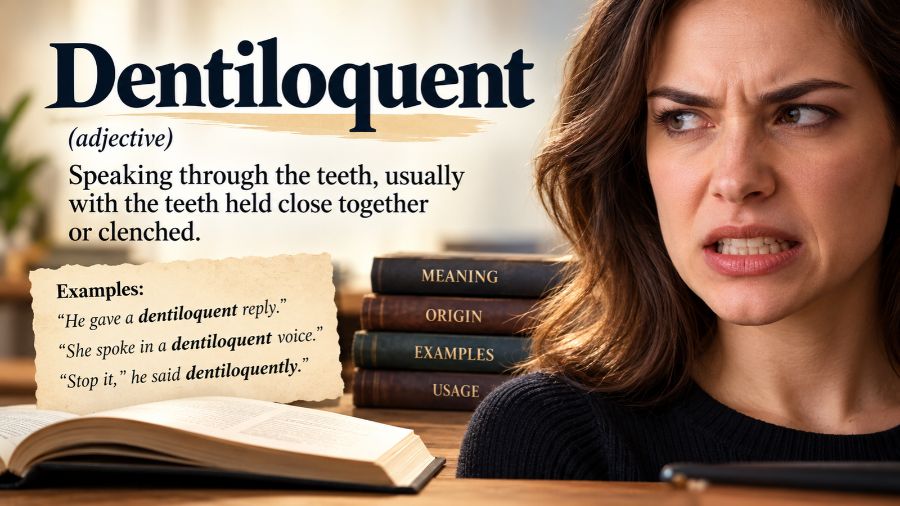
Dentiloquent means speaking through the teeth or speaking with the teeth held close together. It is an adjective used to describe how someone speaks rather than the actual content of their words. For example, a person who says, “Leave me alone,” while keeping their jaw tight and their teeth nearly closed could be described as speaking in a dentiloquent manner. The word is particularly useful when describing a person’s physical delivery of speech. It does not automatically mean that the speaker is angry, threatening, frightened, or frustrated. Those emotions may be suggested by the surrounding situation, facial expressions, or tone of voice, but they are not part of the word’s essential definition.
Dentiloquent Meaning in Simple English
In simple English, dentiloquent means talking through clenched or nearly closed teeth. Imagine someone trying to speak without opening their mouth fully. Their words may sound tense, restrained, or slightly muffled because their teeth remain close together. This is the basic idea behind the term. In ordinary conversation, most people would say that someone is speaking through their teeth instead of using the adjective dentiloquent. However, the rare word can be useful when a writer wants a concise, descriptive expression that captures this specific manner of speaking.
Dentiloquent Meaning in Urdu
In Urdu, dentiloquent can be explained as دانت بھینچ کر بولنا or دانت بند رکھ کر بات کرنا. In Roman Urdu, this means daant bheench kar bolna or daant band rakh kar baat karna. These expressions describe a person speaking while keeping their teeth tightly together or allowing only a small opening between them. Depending on the situation, the manner of speaking might suggest suppressed anger, discomfort, tension, or an attempt to control an emotional reaction. However, these are possible interpretations rather than necessary parts of the definition.
Is Dentiloquent a Real English Word?
Dentiloquent is a historically documented, extremely rare English word, but its dictionary status requires some care. Collins English Dictionary lists it in its New Word Suggestion section with the meaning of talking through one’s teeth and indicates that its usage is being monitored. This is different from appearing as an established entry in the dictionary’s main vocabulary. The related noun dentiloquy also appears in Collins’ suggestion database, where it is defined as speaking through clenched teeth. Therefore, it is reasonable to use dentiloquent in descriptive or literary writing, but it would be misleading to present it as a common word that most English speakers regularly use.
Origin and Etymology of Dentiloquent
The word dentiloquent is built from Latin elements associated with teeth and speaking. Its first part is related to dens, meaning “tooth,” with dentis serving as its genitive form. The second part is connected to loqui, the Latin verb meaning “to speak.” Together, these elements express the idea of speaking through the teeth. The related noun dentiloquy has a documented historical record, with the Online Etymology Dictionary dating it to 1737. That date should not automatically be treated as the first recorded use of the adjective dentiloquent, because the noun and adjective are different word forms with potentially different histories.
What Does the Latin Root Dent Mean?
The Latin root dent- appears in numerous English words associated with teeth. Words such as dental, dentist, dentition, and dentifrice illustrate how this root contributes to English vocabulary. Dentiloquent follows the same broad pattern by combining the tooth-related element with a form associated with speaking. Recognizing this connection can make the meaning easier to remember, even for someone encountering the word for the first time. The root alone does not explain the entire definition, but it provides a useful clue about the physical feature involved in the described manner of speech.
What Does the Root Loqui Mean?
The Latin verb loqui means “to speak” or “to talk” and appears in the histories of several English words associated with speech. For example, soliloquy refers to speech delivered by a person speaking alone, while loquacious describes someone who is talkative. The ending in dentiloquent belongs to this wider family of word forms associated with speaking. Understanding this linguistic connection makes the word less mysterious: its construction combines the idea of teeth with the act of speaking. Nevertheless, knowing the roots is not a substitute for understanding how the complete word is used in context.
Dentiloquent vs. Dentiloquy: What Is the Difference?
Dentiloquent and dentiloquy are related words, but they perform different grammatical functions. Dentiloquent is an adjective that describes a person, voice, response, or manner of speaking, whereas dentiloquy is a noun referring to the act or practice of speaking through the teeth. For example, “His dentiloquent reply surprised everyone” uses the adjective to describe the reply, while “His dentiloquy made the dialogue sound tense” uses the noun to name the speaking style. Both forms communicate a similar central idea, but choosing the correct form helps keep a sentence grammatically natural and clear.
How to Use Dentiloquent as an Adjective
Use dentiloquent when you want to modify a noun associated with speech or a person delivering speech. Expressions such as “a dentiloquent response,” “a dentiloquent voice,” or “a dentiloquent remark” illustrate how the adjective can function in a sentence. It can also be used after a linking verb, as in “His delivery was dentiloquent.” These constructions are understandable in descriptive writing, although the rarity of the word means some readers may need an explanation. When clarity is more important than unusual vocabulary, phrases such as “spoken through clenched teeth” communicate the same basic idea more directly.
How to Use Dentiloquy as a Noun
Dentiloquy names the manner or practice of speaking through the teeth rather than describing something with an adjective. A writer might say, “The character’s dentiloquy added tension to the scene,” using the noun to identify a particular feature of the character’s delivery. The word can be helpful when discussing language, literary descriptions, or unusual vocabulary. However, it is uncommon enough that readers may not recognize it without context. A short explanation on first use can make the meaning accessible without interrupting the flow of the text.
How to Pronounce Dentiloquent
A practical pronunciation guide for dentiloquent is den-TIL-oh-kwent, with the emphasis placed on the middle syllable. This is a useful guide for reading the word aloud, although a single universally established pronunciation should not be assumed for such an uncommon term. The related noun dentiloquy can be pronounced approximately den-TIL-oh-kwee. If you encounter dentiloquent in a text, dividing it into manageable parts can make it easier to say: “den,” “til,” “o,” and “quent.” For everyday communication, however, the phrase “speaking through clenched teeth” is usually easier for listeners to understand immediately.
Examples of Dentiloquent in Sentences
The best way to understand an uncommon word is to see how it functions in context. Dentiloquent works particularly well in sentences that describe dialogue, a character’s voice, or a person’s physical manner of speaking. The following examples illustrate possible uses of the adjective in original sentences.
Dentiloquent Examples in Everyday Situations
Consider the sentence, “He gave a dentiloquent reply when his colleague interrupted him.” Here, the adjective describes the way the reply was delivered, not necessarily the exact emotion behind it. Another example is, “She whispered a dentiloquent warning without opening her mouth fully.” This suggests restrained speech produced through nearly closed teeth. A third example is, “The teacher’s dentiloquent instructions were difficult to understand.” In this case, the unusual delivery interferes with clarity. These are illustrative examples rather than quotations from documented historical texts, and they demonstrate how the adjective can describe different speakers and situations.
Dentiloquent Examples in Fiction and Storytelling
In fiction, dentiloquent can help a writer describe speech without relying on familiar phrases repeatedly. For example, “’Not another word,’ he said in a dentiloquent voice, his jaw rigid.” The sentence combines the rare adjective with a physical detail that helps readers imagine the delivery. Another example is, “The detective’s dentiloquent question made the suspect pause.” This construction describes the detective’s speech while allowing the reader to interpret the situation from its context. Writers should avoid assuming that every dentiloquent character must be angry. A character could speak this way because of restraint, tension, a deliberate acting choice, or another circumstance established by the story.
Dentiloquent Examples in Academic or Vocabulary Writing
In a vocabulary lesson, a writer might explain, “Dentiloquent describes speech produced through the teeth rather than with the mouth opened normally.” Another example is, “The adjective dentiloquent is related in meaning to the noun dentiloquy.” Such sentences use the term to explain language rather than create a dramatic scene. In academic writing, the word should be used only when it adds precision or serves the subject being discussed. Since it is rare, a clear definition at first mention is helpful, especially for audiences unfamiliar with obscure English vocabulary.
What Emotions Can Dentiloquent Speech Suggest?
Dentiloquent speech can be used to portray anger, irritation, restrained frustration, nervousness, or determination, depending on the situation. A person who speaks through clenched teeth may be attempting to keep their emotions under control, while a fictional character may use the same delivery to communicate a quiet threat. However, the physical manner of speaking does not prove any particular emotional state. A person may hold their teeth together for reasons unrelated to anger, and a writer should use context to establish what a character feels. The distinction is important because dentiloquent describes the delivery of speech, while emotional interpretation comes from the wider circumstances.
Dentiloquent Speech and Anger
Anger is a familiar context for describing someone as speaking through clenched teeth. A character who says, “We will discuss this later,” without relaxing their jaw may appear to be concealing frustration. Describing the character’s voice as dentiloquent can reinforce that impression, particularly when paired with other details such as a rigid posture or controlled expression. Even so, the adjective alone does not mean “angry.” If anger is important to a scene, writers should make the emotion understandable through dialogue, action, or context rather than relying on an unfamiliar word to convey the entire meaning.
Dentiloquent Speech and Emotional Restraint
A person may speak through their teeth because they are trying to avoid raising their voice or revealing an emotional reaction. In a tense meeting, for instance, someone might deliver a short, controlled response while keeping their jaw tight. Dentiloquent can describe the physical delivery without deciding whether the person is angry, anxious, embarrassed, or simply exercising restraint. This flexibility makes the term potentially useful in fiction and descriptive prose. It also reinforces why the word should not be treated as a direct synonym for aggression: the manner of speaking and the speaker’s underlying intention are related but distinct things.
Dentiloquent vs. Similar English Words
Several English expressions describe aspects of speech that may seem similar to dentiloquent, but they are not interchangeable in every context. “Speaking through clenched teeth” is the closest plain-English equivalent, while whispering, muttering, hissing, and speaking tersely describe different qualities of voice or delivery. Understanding these distinctions helps writers choose language that accurately communicates what a speaker is doing. The main difference is that dentiloquent focuses on speaking through the teeth or with them held close together. Other terms may emphasize volume, clarity, tone, or the emotional effect of the speech instead.
Dentiloquent vs. Whispering
Whispering generally refers to speaking very quietly, often with little or no vocal-fold vibration. Dentiloquent describes a physical manner of speaking involving the teeth, not a particular volume. Someone can speak dentiloquently at a low volume, but quiet speech alone does not make a person dentiloquent. For example, a person who whispers a secret with their mouth relaxed is whispering without necessarily speaking through their teeth. A person who delivers the same secret with their teeth tightly held together could be described as speaking dentiloquently. The two descriptions can overlap, but they identify different characteristics of speech.
Dentiloquent vs. Mumbling
Mumbling is speech that is difficult to understand because words are not articulated clearly or are spoken indistinctly. Dentiloquent speech may sound muffled when the mouth is barely open, but the words do not have to be unclear. A person could articulate their words carefully while keeping their teeth close together, whereas someone else might mumble with their mouth open normally. The distinction matters when describing dialogue: use mumbling when the main issue is unclear articulation, and use dentiloquent when the defining feature is speaking through the teeth. In some situations, both descriptions might reasonably apply.
Dentiloquent vs. Hissing
Hissing describes a sharp, sibilant sound or a manner of speaking that resembles a hiss. It can suggest anger, secrecy, or menace in fictional dialogue, but it does not necessarily involve clenched teeth. Dentiloquent, by contrast, refers to speech produced through the teeth or with them closed. A character might hiss a warning without keeping their teeth together, or speak dentiloquently without making a pronounced hissing sound. Writers can use both terms when a scene genuinely contains both qualities, but choosing the more precise description prevents readers from imagining a different vocal effect.
Where Is the Word Dentiloquent Most Useful?
Dentiloquent is most useful in contexts where precise description matters more than immediate familiarity. Fiction writers, vocabulary enthusiasts, language students, and editors working with expressive prose may find the word interesting because it names a specific manner of speaking. It can also appear in discussions of unusual English words or in examples designed to explain adjective formation and Latin-derived vocabulary. In general news, business communication, instructional writing, and ordinary conversation, a simpler phrase is usually more effective. The best choice depends on the audience: a rare word can add precision or stylistic variety for some readers, but it can create unnecessary confusion for others.
Using Dentiloquent in Creative Writing
Creative writers often look for concise ways to describe a character’s voice and physical behavior. Dentiloquent can provide an alternative to repeating phrases such as “through clenched teeth” throughout a scene. For example, a novelist might describe a character’s response as dentiloquent and then show the character’s tightly held jaw through an additional detail. This approach can create a vivid image without explaining every movement in lengthy prose. However, the word should not be used simply because it is unusual. If the intended audience is unlikely to understand it, a familiar expression may preserve the scene’s pace and emotional impact more effectively.
Using Dentiloquent in Vocabulary Lessons
For English learners, dentiloquent offers an opportunity to explore how Latin roots contribute to English word formation. Comparing the word with dentiloquy, dental, dentist, and loquacious can help students recognize recurring elements associated with teeth and speech. Teachers can also use short example sentences to demonstrate how an adjective modifies a noun. Because the word is rare, it is better treated as an enrichment item than as essential vocabulary for everyday communication. Learners should first become comfortable with common expressions such as “speaking through clenched teeth,” then explore dentiloquent as a more specialized alternative.
Is Dentiloquent Commonly Used Today?
Dentiloquent remains an uncommon term in contemporary English. Its presence in word-reference databases demonstrates that the form has been recorded, but a dictionary submission does not necessarily establish widespread usage. Collins classifies its entry as a New Word Suggestion and notes that usage is being monitored. This distinction is important when evaluating vocabulary: a word may be understandable and historically documented without being familiar to most readers. Dentiloquent is therefore best described as a rare, specialized adjective rather than a standard everyday expression. Its meaning is clear enough for descriptive use, but writers should consider whether their audience will recognize it without assistance.
Why Is Dentiloquent So Rare?
One likely reason for the word’s limited visibility is that English already has a straightforward expression for the same idea: “speaking through clenched teeth.” Familiar phrases are often easier to understand and more natural in ordinary conversation. Dentiloquent is also relatively long and draws on word elements that many modern English speakers may not recognize. These observations help explain why a precise adjective can remain uncommon, although they do not establish a definitive historical cause for its rarity. The practical lesson is simple: understanding an unusual word is valuable, but using it effectively requires attention to context and audience.
Should You Use Dentiloquent in Everyday Conversation?
For most everyday conversations, the phrase “speaking through clenched teeth” is the more practical choice. It communicates the idea directly, avoids requiring listeners to interpret an unfamiliar word, and fits naturally into many situations. Dentiloquent may be suitable when discussing unusual vocabulary, writing expressive fiction, or deliberately choosing a rare adjective for stylistic effect. If you use it with an audience that may not know the term, the surrounding sentence should make its meaning clear. The aim is not to avoid rare vocabulary entirely, but to choose language that helps readers understand the message without unnecessary effort.
Common Misunderstandings About Dentiloquent
A common misunderstanding is to assume that dentiloquent means angry, threatening, or whispering. In fact, the central meaning concerns the physical manner in which speech is delivered. Another mistake is to treat dentiloquent and dentiloquy as interchangeable grammatical forms, even though one is an adjective and the other is a noun. It is also important not to confuse a documented rare word with a common dictionary entry: the status of a word in a suggestion database may differ from its status in a dictionary’s main vocabulary. Keeping these distinctions clear allows writers and learners to use the term accurately without overstating its meaning or popularity.
Conclusion
Dentiloquent is a rare English adjective describing speech delivered through the teeth or with the teeth held close together. Its Latin roots connect the ideas of teeth and speaking, while the related noun dentiloquy refers to the act or practice of speaking in this manner. The word can add precision to literary descriptions and vocabulary discussions, but its rarity makes it less suitable for most everyday conversations. Understanding its definition, grammatical form, pronunciation, and differences from terms such as whispering and mumbling helps readers use it appropriately. For general audiences, “speaking through clenched teeth” remains the clearest alternative, while dentiloquent offers a more specialized option for those who appreciate unusual English vocabulary.
FAQs
1. What does dentiloquent mean?
Dentiloquent describes someone speaking through their teeth or with their teeth held close together, often creating a restrained or slightly muffled delivery.
2. Is dentiloquent a real English word?
Yes, dentiloquent is a documented but extremely rare English adjective. Its meaning is recognized in word-reference submissions, although it is not commonly used.
3. What is the difference between dentiloquent and dentiloquy?
Dentiloquent is an adjective describing speech delivered through the teeth, whereas dentiloquy is a noun naming the act or practice itself.
4. How do you pronounce dentiloquent?
Dentiloquent can be pronounced approximately den-TIL-oh-kwent, with emphasis on the second syllable, although pronunciation guidance for this rare word is limited.
5. Does dentiloquent mean speaking angrily?
No, dentiloquent describes the physical manner of speaking, not an emotion. Depending on context, the delivery may suggest anger, tension, restraint, or discomfort.
6. What is a common alternative to dentiloquent?
The clearest everyday alternative is “speaking through clenched teeth.” This familiar phrase communicates the meaning directly without requiring readers to know an uncommon adjective.
More read: Gajgry