Image Search Techniques: 9 Practical Ways to Find and Verify Images Online
What Are Image Search Techniques?
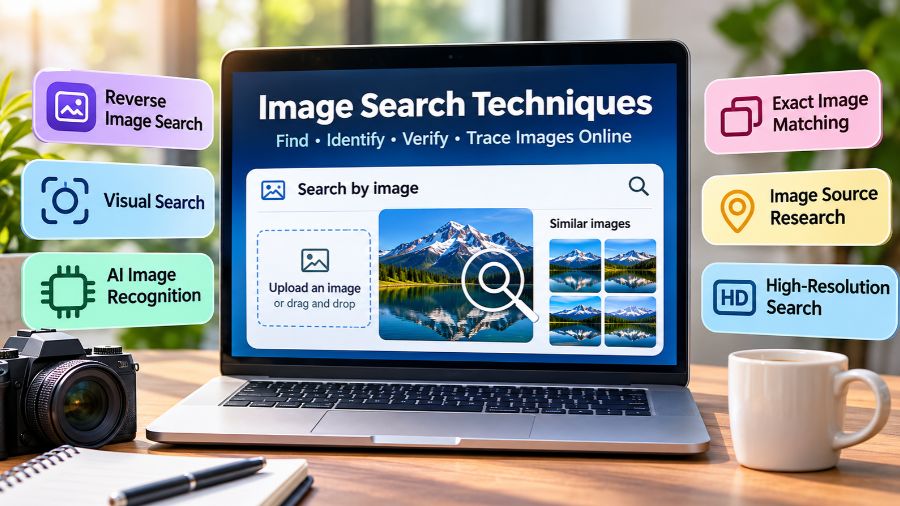
Image search techniques are methods used to locate, identify, compare, and investigate images through search engines and specialised visual discovery tools. Traditional image searches rely on written keywords, descriptions, and related metadata, whereas modern visual search systems can analyse an uploaded photograph and identify objects, patterns, colours, shapes, and other visual characteristics. This allows users to search using an existing image rather than knowing the exact words needed to describe it. Depending on the technology, results may include identical photographs, visually similar pictures, products, websites containing matching images, and information about recognised objects. These techniques are particularly valuable when an image has no caption, its original source is unknown, or a user wants to find alternative versions.
How Image Search Technology Works
Modern image search systems combine computer vision, image recognition, machine learning, and large-scale image indexing to understand and retrieve visual information. When someone uploads a photograph, the search system analyses its visual characteristics and compares them with images available in its searchable index. Some technologies use visual fingerprints to recognise matching photographs, while others analyse objects and contextual features to identify related content. The exact process differs between platforms, but the objective is similar: connect an image with relevant visual information and searchable web content.
Computer Vision and Image Recognition
Computer vision allows software to interpret information contained in digital images. Instead of treating a photograph as an ordinary file, an image recognition system analyses visual patterns that help distinguish objects, shapes, textures, and other characteristics. For example, a system may recognise that a photograph contains a particular type of vehicle, an animal, a building, or a household product. These capabilities support visual discovery even when users cannot provide accurate search terms. Recognition accuracy depends on image quality, available training information, the complexity of the subject, and the technology used.
Visual Fingerprinting and Image Matching
Visual fingerprinting creates a digital representation of an image that can be compared with other photographs in an indexed collection. TinEye uses image recognition technology to create a compact digital fingerprint and identify matching images, including certain cropped, resized, and edited versions. This approach is especially useful when investigating whether the same photograph has appeared on multiple websites. However, image matching and general visual similarity are different processes. A matching system looks for versions of an existing image, whereas a broader visual search system may discover entirely different photographs featuring the same subject.
Artificial Intelligence in Visual Search
Artificial intelligence has expanded image search beyond basic matching. AI-powered systems can interpret image content, recognise multiple objects, and connect visual information with descriptive search queries. Some tools also allow users to combine an uploaded image with additional text to narrow down results. For instance, someone searching for a particular chair can upload its photograph and add a description of the desired colour or design. This combination of visual and text-based searching makes image discovery more flexible and useful.
Nine Effective Image Search Techniques
Different search methods serve different purposes. Selecting an appropriate technique depends on whether someone wants an exact photograph, a similar image, a product identification, or information about an image’s online history. Combining several approaches can produce more useful results than relying on one search engine.
1. Reverse Image Search
Reverse image search is one of the most widely used image discovery techniques. Instead of entering keywords, users upload an existing photograph or provide an image address to find matching or related results. Search engines analyse the submitted image and return relevant visual matches, webpages, and sometimes information about the objects shown. This technique is useful for identifying unfamiliar photographs, checking whether an image appears elsewhere, and discovering alternative versions. Google Lens and TinEye are two established options, although their matching approaches and results differ.
2. Keyword-Based Image Search
Keyword-based image search uses descriptive words to find photographs through traditional search engines. Users can enter a subject, location, object, event, or specific visual characteristic to discover relevant images. More descriptive searches generally help narrow down results. For example, searching for a modern office interior with natural lighting provides more context than searching for office alone. Users can also refine queries by including relevant colours, photography styles, locations, and other identifying details. This technique remains useful when no reference photograph is available.
3. AI-Powered Visual Search
AI-powered visual search interprets the contents of a photograph and identifies objects or related visual information. Google Lens and Bing Visual Search provide examples of this approach. A user can upload a picture of an unfamiliar product, plant, landmark, or everyday object to discover potentially relevant information. Some platforms also support additional text instructions, making it possible to refine searches based on specific requirements. However, AI-generated descriptions and identifications are not always correct, so important information should be checked against reliable sources.
4. Exact Image Matching
Exact image matching focuses on locating identical or modified versions of an existing photograph. It can help identify images that have been resized, cropped, colour-adjusted, or otherwise edited. This method is particularly useful for photographers, publishers, and businesses investigating where their visual content has been reused. TinEye is a recognised tool for this purpose because it focuses on image matches rather than simply finding different photographs of the same subject. Its results depend on the images available in its searchable index.
5. Image Source and Origin Research
Image source research involves investigating where a photograph originally came from and identifying its creator or earliest verifiable publication. Reverse image search can reveal websites displaying the same photograph, helping researchers compare captions, publication information, and available attribution details. This approach is valuable for journalists, content publishers, and researchers who need to establish the background of visual material. However, the earliest result returned by a search engine does not necessarily represent the original publication. Search engine indexing dates, website publication dates, and the actual date a photograph was created are different pieces of information.
6. Image Search Using Cropping
Cropping is a practical technique for improving searches when an image contains several objects, people, or background elements. Rather than uploading the entire photograph, users can select a distinctive section containing the subject they want to identify. For example, cropping a vehicle’s logo or a product’s distinctive design may produce more relevant results than searching the complete photograph. This approach is also helpful when backgrounds, watermarks, or unrelated objects distract visual recognition systems. Trying different crops can help reveal additional matches.
7. High-Resolution Image Search
High-resolution image searching helps users locate larger versions of photographs suitable for closer inspection or professional publishing. Some reverse image search services allow results to be sorted according to image dimensions or file size. TinEye, for example, provides a biggest-image sorting option that can help identify larger matching versions. Nevertheless, higher resolution does not automatically mean better quality, correct attribution, or permission to reuse an image. Publishers should also check the original file quality and applicable licensing conditions before using any photograph.
8. Metadata-Based Image Investigation
Image metadata provides information associated with a digital photograph or image file. Depending on the file and camera settings, metadata may contain details such as the creation date, camera model, image dimensions, and location information. Exchangeable Image File Format, commonly known as EXIF, is one standard used to store photographic metadata. These details can help photographers organise their collections and support certain image investigations. However, metadata is not always available or reliable because editing software, social media platforms, and image-processing tools may remove or change it. Metadata should therefore be treated as supporting information rather than definitive proof of an image’s origin.
9. Multi-Platform Image Searching
Multi-platform searching involves submitting the same photograph to different image search services and comparing their results. Google Lens, Bing Visual Search, TinEye, and Yandex Images each provide different approaches to visual discovery. One platform may identify the subject, another may locate matching webpages, and a third may reveal modified copies. Combining results can improve the chances of finding useful information, particularly when a photograph is difficult to identify. No single platform indexes every publicly accessible image, so different results are normal.
Best Image Search Tools and Their Capabilities
Choosing the right image search tool can make visual research more efficient. Different services specialise in different aspects of image discovery, including object recognition, similar-image recommendations, and exact image matching. Understanding their capabilities helps users select the most appropriate platform.
Google Lens
Google Lens is a visual search technology that helps users identify objects and discover information using photographs. It can return similar images, relevant websites, and search results related to objects visible in a picture. Users can upload an image, search with a camera, or select an image encountered while browsing in supported environments. Another useful capability is combining visual searches with additional descriptive text. Google Lens is particularly suitable for general-purpose visual discovery and identifying unfamiliar objects.
TinEye
TinEye is a reverse image search engine designed to locate matching images across the web. Its technology uses visual fingerprints rather than relying on image filenames, keywords, or watermarks. Users can upload photographs, paste images, or search using image addresses. Results can be sorted by factors such as best match, biggest image, most changed, newest, and oldest crawled image. These features make TinEye useful for tracking image reuse and finding modified or larger versions of photographs.
Bing Visual Search
Bing Visual Search allows users to search the web using photographs instead of traditional written queries. It can return related images, webpages containing an image, products, and other relevant information. Users can upload files, paste images, provide image addresses, or use supported camera features. Its AI-assisted visual understanding helps interpret image contents and identify potentially relevant information. It is a useful alternative when another search engine does not return sufficient results.
Yandex Images
Yandex Images provides image discovery and visual matching capabilities. Users can search for pictures, find visually similar content, and investigate images through its visual search functionality. Its computer vision technology can identify matching photographs and related images, making it another option for cross-platform research. Using Yandex alongside other image search services can sometimes reveal results that are not immediately visible through a single platform.
Practical Applications of Image Search Techniques
Image searching has applications across several industries because photographs often contain information that is difficult to describe through text alone. In digital journalism, reverse image searches can help investigate the context of photographs and identify potentially misleading visual material. In e-commerce, shoppers can use visual searches to discover products based on their appearance rather than product names. Photographers and publishers can investigate where their work appears online, while researchers can use visual matching to identify relevant material. Educational institutions and students can also use image recognition to investigate unfamiliar objects, landmarks, historical photographs, and scientific illustrations. These applications demonstrate why visual search has become an important part of modern information discovery.
Benefits of Using Advanced Image Search Methods
Advanced image search methods save time by allowing people to search through visual information without always knowing the correct terminology. Reverse image search can help identify matching photographs, while AI-powered recognition makes it easier to discover unfamiliar objects. Multiple search engines provide alternative perspectives and increase the likelihood of finding useful results. Image matching can also support copyright investigations, content verification, and duplicate detection. For businesses, visual search can improve product discovery and help customers locate items using reference photographs. For publishers, it can support image research and help identify suitable visual material for editorial content.
Challenges and Limitations of Image Search Technology
Despite improvements in computer vision, image search is not completely reliable. Results depend on the quality of the submitted photograph, the search engine’s image index, and the recognition technology used. Poor lighting, unusual angles, heavy editing, low resolution, and partial obstructions can make image identification difficult. Another limitation is that different platforms may return inconsistent results because their indexes and algorithms are not identical. Image search also cannot independently establish copyright ownership or prove that a photograph is authentic. AI-powered systems may incorrectly identify people, objects, locations, or events. For this reason, important findings should be checked against original publications, credible records, and independent evidence.
Image Search, Privacy, and Copyright Considerations
Using image search responsibly requires attention to privacy, data protection, and intellectual property rights. Photographs may contain faces, private documents, addresses, location information, or other sensitive details. Before uploading an image to an external search service, users should consider whether sharing that material is appropriate and review the platform’s privacy policies. Copyright is another important consideration because finding a photograph through a search engine does not grant permission to download, edit, or republish it. Users should check the creator’s information, licensing terms, and any required attribution. Commercial publishers should obtain appropriate permission or use images with clearly applicable licences. Responsible image research involves checking both the accuracy of visual information and the legal conditions governing its use.
The Future of Image Search Technology
The future of image search is likely to involve increasingly sophisticated combinations of artificial intelligence, computer vision, natural language processing, and visual recognition. Search systems are becoming more capable of understanding complex photographs and responding to descriptive queries. Multimodal AI also allows visual information to be considered alongside written instructions, making searches more flexible. Improvements in object detection and image comparison may support better research, product discovery, and content verification. However, greater recognition capabilities will not eliminate challenges involving privacy, manipulated images, copyright, or inaccurate AI-generated information. Reliable verification and responsible use will remain essential as visual search technology develops.
Conclusion
Image Search Techniques have become valuable tools for finding, identifying, comparing, and verifying visual information across the internet. Reverse image search, AI-powered recognition, visual fingerprinting, cropping, metadata investigation, and multi-platform searching each offer different advantages depending on the task. Tools such as Google Lens, TinEye, Bing Visual Search, and Yandex Images make these methods accessible to everyday users and professionals. However, search results should not automatically be treated as proof of authenticity, ownership, or original publication. Combining multiple techniques with careful source verification, privacy awareness, and copyright checks provides a more reliable approach to modern visual research.
FAQs
What is the most effective image search technique?
Reverse image search is highly effective for finding matching photographs, while AI-powered visual search is useful for identifying objects and discovering related information.
Can I find the original source of a photograph?
Yes, reverse image search can reveal matching webpages, but the earliest indexed result does not necessarily identify the original photographer or publication.
Which tool is best for reverse image searching?
Google Lens is useful for general visual discovery, while TinEye specialises in finding exact and modified image matches across its indexed collection.
Can image search identify people and objects?
Visual search can recognise many objects and visual features, but identifying individuals requires additional care because automated recognition can produce inaccurate results.
How can I find higher-resolution versions of images?
Upload the photograph to a reverse image search service and use available size filters or sorting options to locate larger matching versions.
Is it legal to reuse images found through reverse image search?
Not automatically. Image reuse depends on copyright ownership, licensing terms, permissions, and applicable legal exceptions in the relevant jurisdiction.
More read: Eleksan