N-m ft-lb Conversion: Essential Torque Formula, Chart and Practical Guide
What Does N-m ft-lb Mean?
N-m ft-lb refers to the relationship between two units used to measure torque, also known as the moment of force. Torque describes the turning effect produced when a force acts at a distance from a pivot or rotational axis. Newton-metre is the standard metric unit, while foot-pound is a commonly used imperial unit. Both measurements describe the same physical quantity, but their numerical values differ because the units use different scales. Understanding this distinction is particularly useful when reading vehicle repair manuals, equipment specifications, engineering documents, and torque wrench settings. The abbreviation N-m is often written more formally as N·m, while ft-lb may also appear as lb-ft or lbf·ft. In torque applications, these notations generally refer to foot-pounds of force, although the exact terminology depends on the document.
Understanding Newton-Metres and Foot-Pounds
What Is a Newton-Metre?
A newton-metre is a unit of torque in the International System of Units, commonly known as SI. One newton-metre represents the torque produced by a force of one newton acting perpendicular to a lever arm one metre long. For example, applying a perpendicular force of 10 newtons at a distance of one metre from a pivot produces 10 N·m of torque. The actual turning effect depends on the force’s direction and its perpendicular distance from the axis. Newton-metres are widely used in engineering, automotive service information, industrial maintenance, and technical specifications because they belong to the metric measurement system. Although the newton-metre is also dimensionally equivalent to a joule, the two units represent different physical quantities in practical use: torque describes a turning effect, whereas a joule measures energy or work.
What Is a Foot-Pound?
A foot-pound, when used to describe torque, means a pound-force foot: the turning effect produced by a force of one pound-force acting perpendicular to a lever arm one foot long. It is commonly written as ft-lb, ft-lbf, or lb-ft, depending on the manufacturer, industry, or publication. This unit appears frequently in American automotive specifications, mechanical tools, and equipment documentation. For instance, a torque setting of 50 ft-lb describes a particular rotational effect, not the mass of an object weighing 50 pounds. The distinction between pound-force and pound-mass matters because force and mass are separate physical quantities. When converting torque values, use the force-based foot-pound unit rather than confusing it with foot-pounds of energy or other quantities that may share similar abbreviations.
Why Are Both Units Used?
Newton-metres and foot-pounds coexist because industries and countries use different measurement conventions. Metric specifications are common in international engineering and vehicle documentation, while foot-pounds remain familiar in many American workshops and tool specifications. Equipment manufacturers may also supply products intended for multiple markets, resulting in manuals that show both units. A technician could encounter a bolt specification in N·m but own a torque wrench calibrated in ft-lb. Conversion allows the technician to interpret the specification without changing the physical requirement. However, the original manufacturer specification should remain the reference point, especially for safety-critical fasteners. The purpose of conversion is to express the same torque in a different unit, not to select a different tightening force or substitute an approximate value without considering the required precision.
N-m to ft-lb Conversion Formula
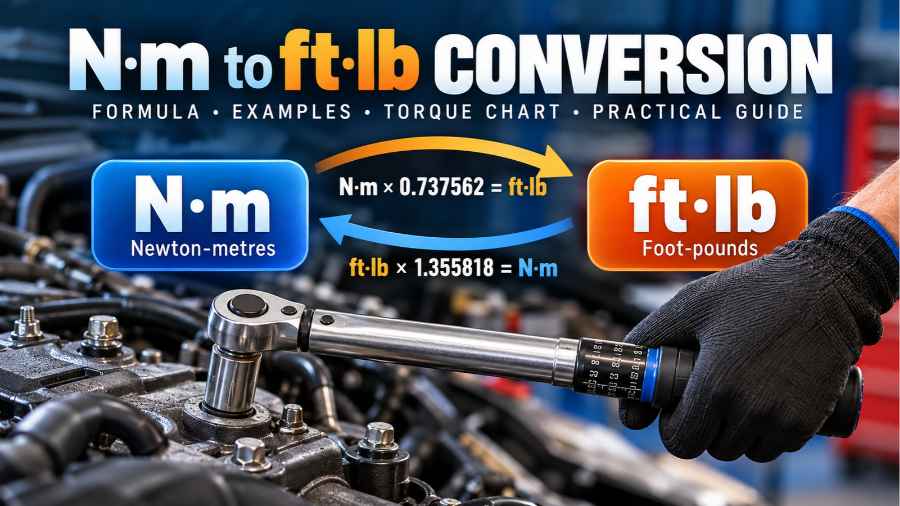
The standard conversion factor makes it possible to convert newton-metres into foot-pounds using a straightforward multiplication. One newton-metre is approximately equal to 0.737562 ft-lb, while one foot-pound is approximately equal to 1.355818 N·m. These factors are consistent with conversion data published by the US National Institute of Standards and Technology. To convert N·m to ft-lb, multiply the newton-metre value by 0.737562. For example, 100 N·m multiplied by 0.737562 equals approximately 73.76 ft-lb. To convert in the opposite direction, multiply the foot-pound value by 1.355818. These formulas are suitable for ordinary calculations, but the number of decimal places retained should reflect the precision needed for the application and the accuracy of the measuring tool.
How to Convert N-m into ft-lb
To perform the conversion manually, first identify the torque value expressed in newton-metres. Multiply that number by 0.737562, then round the result appropriately for the task. Suppose a repair manual specifies 80 N·m. Multiplying 80 by 0.737562 gives approximately 59.00 ft-lb. A torque wrench calibrated in foot-pounds can therefore be set to about 59 ft-lb if that precision is suitable and the manufacturer’s instructions permit the conversion. The calculation does not require a special engineering background or an online calculator. Nevertheless, always confirm that the value being converted is torque rather than another quantity, and avoid rounding aggressively when the specified torque is critical to the safe operation of a vehicle or machine.
How to Convert ft-lb into N-m
Converting foot-pounds into newton-metres follows the reverse process. Multiply the original ft-lb value by 1.355818 to obtain the equivalent torque in N·m. For example, a specification of 40 ft-lb corresponds to approximately 54.23 N·m. This conversion is useful when a manual, drawing, or equipment label uses imperial units but the available torque wrench displays metric values. The converted number should be rounded to a level that the tool can reliably measure without exceeding the manufacturer’s specified tolerance. A conversion result with several decimal places does not mean that a workshop torque wrench can reproduce that exact value. The displayed precision, calibration, and measurement range of the tool all affect how practically useful the converted number is.
N-m to ft-lb Conversion Examples
Practical examples make the relationship between metric and imperial torque units easier to understand. A setting of 10 N·m equals approximately 7.38 ft-lb, while 25 N·m equals 18.44 ft-lb. A value of 50 N·m converts to 36.88 ft-lb, and 100 N·m converts to 73.76 ft-lb. Larger values follow exactly the same formula: 150 N·m is approximately 110.63 ft-lb, and 200 N·m is approximately 147.51 ft-lb. These examples are rounded for convenient reference rather than intended to replace a manufacturer’s specifications. When converting an actual fastener setting, use the precise original value and the appropriate conversion factor, then account for the measuring tool’s resolution and the tolerance permitted by the equipment manufacturer.
Common Conversion Values to Remember
Several familiar values can make quick mental estimates easier during routine work. One N·m is about 0.74 ft-lb, 10 N·m is about 7.38 ft-lb, and 100 N·m is about 73.76 ft-lb. In the opposite direction, 10 ft-lb is approximately 13.56 N·m, while 50 ft-lb is approximately 67.79 N·m. These rounded figures are useful for checking whether a calculator result looks reasonable, but they should not replace accurate calculations for critical applications. Remembering that a foot-pound is approximately 1.356 times a newton-metre can also help identify an incorrect conversion. If a calculation says that 100 N·m equals 135 ft-lb, for example, the conversion direction has probably been reversed or the wrong factor has been used.
What Is Torque and How Does It Work?
Torque describes how strongly a force tends to rotate an object around a pivot or axis. Its magnitude depends on the applied force, the distance from the axis, and the angle at which the force acts. When force is applied perpendicular to a lever, torque is calculated by multiplying the force by the lever-arm length. When the force acts at another angle, the effective turning component must be considered. This explains why a longer wrench can produce more torque with the same perpendicular force than a shorter wrench. Torque is important in applications ranging from turning a simple hand tool to operating an engine shaft or tightening a threaded fastener. Understanding this principle helps explain why torque specifications are expressed in units such as N·m and ft-lb rather than in units of mass or distance alone.
Why Lever Length Matters
Lever length affects the torque produced by a given force because torque increases with the perpendicular distance from the rotational axis. For example, applying a perpendicular force of 20 newtons at a distance of 0.5 metres creates 10 N·m of torque. Applying the same force at one metre creates 20 N·m. This relationship is useful when understanding ordinary tools, but it should not be treated as permission to extend a torque wrench with an unapproved pipe or attachment. Changing the effective length or grip position of a torque tool can affect the delivered torque and may invalidate the indicated setting. For precision work, follow the tool manufacturer’s instructions, including any restrictions on extensions, adapters, and approved measurement methods.
Why Accurate Torque Settings Matter
Correct torque settings help fasteners achieve the clamping force intended by their designers. Under-tightening may allow a joint to loosen, move, leak, or experience repeated movement, while excessive tightening can stretch a bolt, damage threads, deform components, or cause a fastener to fail. The relationship between applied torque and clamping force is influenced by friction, lubrication, thread condition, surface finish, and fastener geometry, so torque alone does not guarantee an identical clamping force in every situation. This is why vehicle manufacturers, machinery suppliers, and engineering documents specify particular tightening procedures rather than a universal setting. Using the correct N·m or ft-lb value is one part of the process; using the right fastener, tightening sequence, tool, and preparation method is equally important for a reliable assembly.
Automotive Maintenance and Repairs
Automotive repair is one of the most familiar applications for torque conversion. Service information may specify torque for wheel fasteners, engine components, suspension parts, brake assemblies, or other threaded connections. A technician using a torque wrench marked in a different unit system must convert the specified value correctly before tightening the fastener. However, the appropriate setting depends on the vehicle’s make, model, year, component, and sometimes the exact fastener or repair procedure. There is no single torque value that is safe for all wheel nuts or engine bolts. For safety-critical work, consult the correct service manual and follow any required tightening sequence, angle-tightening step, replacement instruction, or lubrication condition. A mathematically correct conversion cannot compensate for using the wrong original specification.
Industrial Machinery and Mechanical Engineering
In industrial settings, torque values are used in assembly procedures, maintenance schedules, rotating equipment, and mechanical design. Engineers and technicians may encounter metric values in technical drawings and imperial values in equipment imported from another market. Converting the units helps teams interpret the same specification consistently across documents and tools. Accuracy becomes particularly important when working with large fasteners, machinery under load, or assemblies where a failure could damage equipment or endanger people. Conversion should be incorporated into documented procedures when required, with clear unit labels to reduce confusion between teams. Where calibrated equipment or a formal quality process is required, technicians should follow the approved procedure instead of relying solely on mental arithmetic or a rounded conversion estimate.
Bicycles, Motorcycles, and DIY Projects
Torque specifications also matter when assembling bicycles, motorcycles, furniture mechanisms, and other products that use threaded fasteners. Lightweight components, especially those made from aluminium or carbon fibre, may be vulnerable to damage if fasteners are tightened beyond their specified limits. A torque wrench helps apply a controlled setting, provided it is suitable for the low or high torque range involved and is used according to its instructions. For bicycles and motorcycles, the manufacturer’s recommended torque should take priority over a general conversion chart or advice intended for a different component. DIY users should also distinguish between torque specifications for ordinary fasteners and instructions involving thread-locking compounds, special washers, lubrication, or tightening angles. Correct conversion supports safe assembly, but the product’s own procedure remains essential.
Choosing and Using a Torque Wrench
A torque wrench is designed to apply or measure torque within a specified operating range. Common types include click-style, beam-style, dial, and electronic torque wrenches, each with its own method of indicating the applied torque. Some tools use N·m, others use ft-lb, and some display both. Before use, check the scale, operating range, accuracy specifications, calibration status where applicable, and the manufacturer’s instructions. Select a tool whose range suits the required setting rather than relying on a wrench operating at an unsuitable extreme of its scale. During tightening, keep the tool aligned as instructed and apply force smoothly. Avoid using a torque wrench as a general-purpose breaker bar unless the manufacturer explicitly permits it, because misuse can affect the tool’s accuracy or damage its mechanism.
Reading Metric and Imperial Scales
When a torque wrench includes both metric and imperial markings, identify the correct scale before adjusting the tool. The two scales may be printed close together, and selecting the wrong one can create a substantial error. A setting of 70 on the N·m scale is not equivalent to 70 on the ft-lb scale; 70 N·m is approximately 51.63 ft-lb. Electronic models may allow users to change displayed units, but the selected unit must be checked before applying torque. If markings are worn, difficult to read, or ambiguous, consult the manufacturer’s manual rather than guessing. A short pause to confirm the unit, value, and tool range can prevent incorrect tightening and unnecessary damage to fasteners or components.
Calibration, Accuracy, and Maintenance
Torque wrenches are measuring tools, and their accuracy can change through wear, impact, misuse, or normal use over time. Calibration requirements depend on the tool, its use, applicable standards, and workplace procedures; there is no single interval that is correct for every wrench. Users should inspect tools for visible damage and follow the manufacturer’s storage and maintenance recommendations. Some click-style wrenches require the setting to be returned to a designated minimum scale value for storage, but the correct practice depends on the specific model. Calibration certificates and records may be required in professional environments. If a wrench has been dropped, overloaded, damaged, or suspected of giving inconsistent readings, follow the manufacturer’s guidance on inspection and recalibration before relying on it for critical work.
N-m, ft-lb, and in-lb: Understanding the Difference
Foot-pounds and inch-pounds are both imperial torque units, but they are not numerically interchangeable. One foot-pound equals 12 inch-pounds, because one foot contains 12 inches. Therefore, 10 ft-lb equals 120 in-lb, and 120 in-lb equals 10 ft-lb. Confusing these units can produce a major tightening error, particularly when a small fastener requires a setting in inch-pounds but the tool is adjusted in foot-pounds. Newton-metres are a metric unit and can also be converted to inch-pounds; one N·m is approximately 8.85075 in-lb. Always check whether a manual specifies N·m, ft-lb, or in-lb before adjusting a torque wrench. The unit label is just as important as the numerical value.
Common N-m ft-lb Conversion Mistakes
A frequent mistake is multiplying by the correct conversion factor in the wrong direction. To convert N·m into ft-lb, multiply by approximately 0.737562; to convert ft-lb into N·m, multiply by approximately 1.355818. Another mistake is confusing torque with energy because both newton-metres and foot-pounds can appear in discussions of mechanical work. Although the units have related dimensions, torque and energy describe different physical quantities and should be interpreted according to context. Users may also round too early, mistake inch-pounds for foot-pounds, or assume a converted number overrides a manufacturer’s procedure. Avoid these errors by writing down the original value and unit, selecting the correct formula, checking the result’s approximate size, and confirming the final setting against the tool’s scale.
Advantages and Limitations of Torque Conversion
Converting N·m to ft-lb makes technical information easier to use across measurement systems, supports compatibility between manuals and tools, and reduces the need to purchase another wrench solely because it uses a different scale. A consistent conversion method also helps maintenance teams communicate specifications clearly. However, conversion has limitations: rounding can affect the final setting, measuring tools have finite accuracy, and torque does not translate directly into an exact fastener clamping force under every condition. A conversion calculator also cannot tell you whether the original torque specification is correct for a particular vehicle or machine. The most reliable approach is to begin with verified manufacturer documentation, convert only when necessary, preserve the intended precision, and use an appropriate tool in good condition.
How to Convert Torque Values More Reliably
A reliable conversion process begins by identifying the original unit and confirming the intended torque specification. Use a calculator or a trusted conversion tool when the value is unfamiliar, then check the result against the appropriate conversion factor. For workshop tasks, retain enough decimal places to avoid unnecessary rounding, but do not mistake mathematical precision for tool accuracy. If a manufacturer’s procedure specifies a particular unit, tightening sequence, or additional angle, follow those instructions rather than simplifying the process to a single converted number. For repeated professional work, a documented conversion method can reduce unit-selection errors and make quality checks more consistent. These precautions are particularly valuable when working on vehicles, machinery, or structural assemblies where an incorrect torque setting could have serious consequences.
Conclusion
N-m ft-lb conversion provides a practical way to interpret torque specifications across metric and imperial measurement systems. The essential formula is straightforward: multiply N·m by 0.737562 to obtain ft-lb, or multiply ft-lb by 1.355818 to obtain N·m. Understanding torque, choosing the correct unit, and using an appropriate torque wrench are important for accurate mechanical work. Although conversion charts and calculators make the process easier, the manufacturer’s specifications should always guide the final setting. By checking units, avoiding premature rounding, and following the correct tightening procedure, readers can use torque measurements more confidently in automotive maintenance, engineering, machinery servicing, and DIY applications.
FAQs
1. How many ft-lb is 1 N-m?
One newton-metre is approximately 0.737562 foot-pounds. Multiply any N·m value by this factor to calculate its equivalent torque in ft-lb.
2. How do you convert N-m to ft-lb?
Multiply the torque value in newton-metres by 0.737562. For example, 100 N·m equals approximately 73.76 ft-lb.
3. How many N-m is 100 ft-lb?
One hundred foot-pounds equals approximately 135.58 N·m. Multiply the original ft-lb value by 1.355818 to convert it into newton-metres.
4. Are ft-lb and lb-ft the same?
Yes, ft-lb and lb-ft commonly represent the same torque unit, foot-pound-force. Always check the surrounding context to confirm that the measurement refers to torque.
5. Is N-m the same as a joule?
A newton-metre and a joule have equivalent dimensions, but torque and energy describe different physical quantities. Their units should not be treated as interchangeable in context.
6. Why is the correct torque setting important?
Correct torque helps fasteners achieve their intended clamping force. Incorrect settings can loosen joints, damage threads, stretch bolts, or cause component failure.
More read: Target Company URL Research