Zecway Explained: AI Workplace Search, Features, Benefits and Limitations
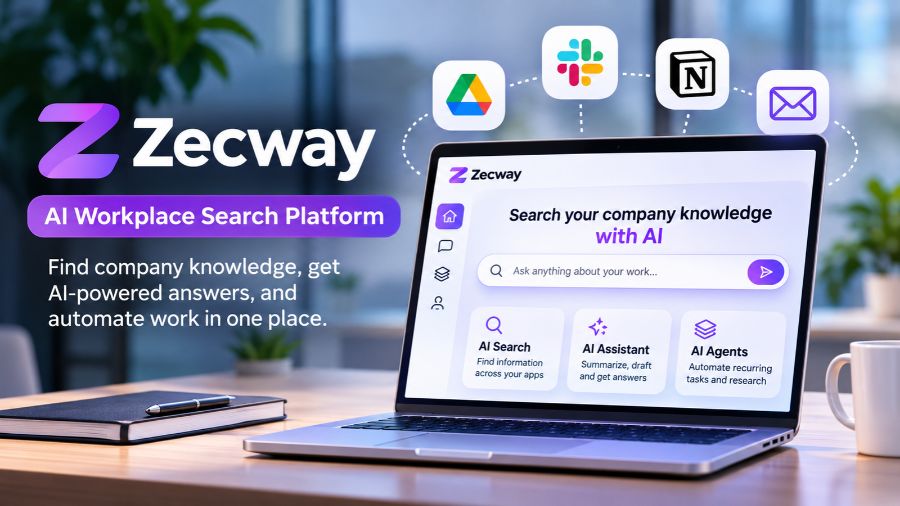
Zecway is an emerging AI-powered workplace knowledge platform designed to help businesses find information, understand company documents, and manage everyday tasks through a unified search experience. As organizations increasingly rely on applications such as Google Drive, Slack, Notion, and email, important information often becomes scattered across different systems. Zecway aims to address this challenge by combining enterprise search, an AI-powered assistant, and automated agents in one platform. Its approach reflects a growing shift toward AI-driven workplace productivity, where employees can access relevant company knowledge without manually searching multiple applications.
What Is Zecway?
Zecway is an AI-powered workplace search and knowledge management platform that aims to make company information easier to discover and use. Rather than functioning as a traditional search engine, it is designed to connect information from different business applications and provide answers through natural-language questions. Employees can search for documents, conversations, business updates, and other organizational information from a centralized interface. The platform also introduces AI assistance and workflow automation as part of its broader vision. Its official website describes this approach as creating a company-wide knowledge system that brings scattered information together while maintaining access permissions. Zecway is currently promoting its product through an early-access program, meaning its advertised capabilities should be distinguished from features that have been independently tested in everyday business environments.
How Does Zecway Work?
Zecway is designed around the idea that employees should not need to remember where information is stored before they can find it. Instead, its proposed workflow connects different workplace information sources and makes their contents searchable through a unified interface. When an employee submits a question, the system aims to identify relevant information, retrieve supporting documents, and generate an answer with references to its underlying sources. Its approach combines information retrieval with AI-generated responses, allowing users to move from searching for a document to understanding its contents. The platform also describes permission-aware search, an AI assistant, and agents that can perform recurring tasks. However, actual performance depends on supported integrations, data quality, configuration, and the reliability of its underlying technology.
Connecting Workplace Applications
One of Zecway’s central ideas is bringing information from multiple workplace applications into one searchable experience. Its public product description mentions services such as Google Drive, Slack, Notion, and email as examples of information sources. This approach could help businesses where documents, project discussions, customer information, and internal decisions are distributed across separate platforms. Instead of opening several applications and repeating the same search, employees could ask a question through a centralized interface. The availability and depth of individual integrations should be confirmed directly with the company before an organization depends on them.
Natural-Language Search and AI Responses
Traditional workplace search often depends on exact keywords, document titles, or remembered file locations. Zecway aims to make this process more conversational by allowing employees to describe what they need in ordinary language. For example, someone might ask where the latest pricing presentation is stored or request information about a previous project decision. The system is designed to identify relevant company information and return an answer supported by source references. This can make information discovery more accessible to employees who are unfamiliar with internal file structures, although the accuracy of each response still depends on the quality and relevance of retrieved information.
Source-Based Answers
Another important part of Zecway’s positioning is its emphasis on answers supported by company sources. AI-generated responses can sometimes contain outdated information, misunderstand context, or produce statements that are not supported by available records. Linking answers to original documents and conversations gives employees an opportunity to verify important details before acting on them. This is particularly useful for business decisions involving policies, pricing, project requirements, and customer commitments. However, having a citation does not automatically guarantee that an answer is correct. Users should still check the referenced material, its publication date, and whether it represents the latest approved information.
Key Features of Zecway
Zecway presents itself as more than a centralized workplace search tool. Its product concept includes three connected capabilities: search, an AI assistant, and automated agents. Together, these components are intended to help organizations move from locating information to preparing useful work and eventually automating selected business processes. The official product presentation highlights source-backed responses, permission-aware information retrieval, and task-oriented automation. Because the platform is being introduced through early access, businesses should verify which capabilities are currently available rather than assuming every advertised function is fully operational for all customers.
Unified Enterprise Search
Unified enterprise search is the foundation of the Zecway experience. It aims to make information from connected business applications accessible through one search interface. This can be valuable for organizations that manage large collections of documents, project discussions, internal presentations, and operational records. Employees can potentially spend less time switching between applications and more time using the information they discover. The usefulness of this feature will depend on integration coverage, search quality, indexing frequency, and how effectively the platform handles different document types.
AI-Powered Workplace Assistant
Zecway also describes an AI assistant that can help employees prepare drafts, summaries, and business-related responses using organizational knowledge. For example, an employee could request a draft response to a business proposal based on relevant company policies and previously approved documents. The assistant is intended to provide contextual information rather than relying entirely on general AI knowledge. This could make routine writing and information analysis more efficient. Nevertheless, generated content should be reviewed before being shared externally, especially when it involves legal commitments, financial information, customer agreements, or confidential business decisions.
Automated AI Agents
AI agents represent another part of Zecway’s broader product direction. Unlike a conventional chatbot that primarily responds to questions, an AI agent is designed to carry out a sequence of tasks toward a defined objective. Zecway describes agents that can perform scheduled research, prepare work, and initiate actions that require human approval. For example, a business might want an automated process to collect information every Monday, organize findings, and prepare a summary for review. This approach could reduce repetitive administrative work. However, organizations should establish clear approval requirements, activity monitoring, and safeguards before allowing automated systems to interact with business applications.
Permission-Aware Information Access
Information security is an important consideration for any platform that connects multiple workplace applications. Zecway emphasizes permission-aware search, meaning employees should only receive information they are authorized to access. Its website describes access enforcement at the database level before information reaches an AI system. This is an important design objective because a centralized search tool should not expose confidential documents simply because they are connected to the same workspace. Businesses should still test access controls using different employee roles, private documents, revoked permissions, and shared folders before connecting sensitive information.
Benefits of Using Zecway for Businesses
The potential value of Zecway comes from reducing the effort involved in finding and using organizational information. Businesses often accumulate knowledge across cloud storage, communication platforms, email accounts, and project management systems. When employees cannot locate relevant information quickly, they may repeat research, ask colleagues for documents, or recreate work that already exists. A unified search and AI assistance platform could help address these inefficiencies. It may also improve access to institutional knowledge, support internal collaboration, and simplify selected administrative activities. However, the actual return on investment will depend on implementation costs, employee adoption, integration quality, and measurable improvements in daily workflows.
Improved Information Discovery
A centralized search experience can make it easier for employees to locate documents and discussions without remembering which application contains them. This is especially relevant for growing companies where information is created by multiple departments. Faster discovery can help employees prepare reports, review previous decisions, and understand ongoing projects with less manual searching.
Better Workplace Productivity
An AI assistant may reduce the time required to summarize documents, prepare internal drafts, and collect information from different sources. Instead of manually reviewing multiple records, employees could use natural-language questions to identify relevant material. The greatest benefit would come from using AI to support repetitive information-related work while keeping employees responsible for important decisions.
Greater Access to Organizational Knowledge
Businesses often depend on employees who understand where important information is stored and how previous decisions were made. When these employees leave or change roles, useful knowledge can become difficult to access. A searchable organizational knowledge system could help preserve institutional information and make it more accessible to other team members, provided that documents are properly maintained and permissions are configured correctly.
Who Can Benefit From Zecway?
Zecway’s intended audience includes businesses that depend on multiple digital applications to manage internal information and coordinate work. Its LinkedIn company profile describes a focus on teams with approximately 30 to 500 employees. This positioning suggests that the platform is particularly relevant to growing organizations that have accumulated substantial workplace information but may not have a unified way to search it. Technology companies, consulting businesses, marketing agencies, operations teams, and other information-intensive organizations could potentially benefit from this approach. Smaller businesses may also find the concept useful, although its suitability will depend on available integrations, pricing, onboarding requirements, and actual business needs.
Technology and Software Companies
Software companies generate large amounts of technical documentation, project discussions, product requirements, and internal knowledge. A centralized workplace search platform could help developers, project managers, and support teams locate relevant information without repeatedly asking colleagues. AI assistance could also help summarize technical discussions and prepare internal documentation, subject to appropriate review.
Marketing and Consulting Agencies
Marketing and consulting agencies frequently manage client presentations, research documents, campaign information, and project communications. A unified search system could help employees find previous work and identify relevant information when preparing new proposals. This may be particularly useful for agencies handling several clients and projects simultaneously.
Growing Businesses and Operations Teams
Growing organizations often introduce new software applications as their operations expand. Over time, information becomes distributed across different systems, making internal knowledge harder to manage. Zecway’s approach could provide a more centralized way to discover company information and support recurring administrative processes.
Zecway Pricing and Availability
As of November 2026, Zecway’s official website promotes a limited early-access program and indicates that users do not need a credit card to request access. Interested businesses can register using a work email address. However, publicly available information does not establish a complete standard pricing structure, including confirmed monthly subscriptions, per-user charges, enterprise packages, or usage-based fees. Early-access registration should not be interpreted as confirmation of a permanently free plan. Businesses considering adoption should contact the company to clarify subscription costs, onboarding arrangements, supported integrations, feature availability, and any limitations associated with early access.
Zecway vs Traditional Workplace Search Tools
Traditional workplace search tools generally focus on locating documents, emails, messages, and other stored information. Zecway aims to extend this experience by combining search with an AI assistant and task-oriented agents. This creates a broader workflow in which employees can potentially discover information, receive contextual answers, prepare business content, and automate selected activities. The distinction is important because searching for information and acting on information are different business requirements. Nevertheless, established workplace search products may already offer mature integrations, administrative controls, and enterprise support. Businesses should compare Zecway with their existing software and other enterprise AI search solutions based on practical requirements rather than assuming that a newer AI platform is automatically better.
Challenges and Limitations of Zecway
Despite its potential, Zecway faces several challenges common to emerging AI workplace platforms. Integration quality is a major consideration because incomplete connections can leave important company information outside the searchable system. AI-generated responses also depend on the accuracy, relevance, and freshness of available documents. Another challenge is maintaining appropriate access controls across applications that may use different permission structures. Businesses must also consider employee adoption, implementation requirements, data protection, and the reliability of automated actions. Since public information about independent testing, comprehensive technical documentation, and general commercial availability remains limited, organizations should conduct their own evaluation before relying on the platform for important operations.
Data Privacy and Security
Connecting business applications to an external AI platform introduces questions about data storage, processing, retention, and third-party access. Companies should review the provider’s privacy policy, data-processing agreement, security documentation, encryption practices, and incident response procedures. They should also ask whether submitted information is used to train AI models and how data can be exported or deleted. Zecway’s public emphasis on data ownership and permission-aware access is relevant, but these statements should not replace independent security verification.
Accuracy of AI-Generated Information
AI systems can misunderstand documents, overlook important context, or combine information from outdated sources. These risks become more significant when employees use generated answers for financial, operational, or contractual decisions. Source references can help users verify information, but businesses should establish review procedures for important outputs and ensure that employees understand the limitations of AI-generated responses.
Integration and Implementation Requirements
A workplace search platform is only as useful as the information sources it can access reliably. Businesses should confirm which applications are supported, whether integrations require administrator approval, and how frequently information is synchronized. They should also assess how the system handles deleted documents, changed permissions, duplicate files, and conflicting versions of company records.
The Future Potential of Zecway
Zecway represents a broader development in enterprise software: the movement from traditional information storage toward AI-assisted knowledge management and workflow automation. As businesses adopt more AI tools, the ability to retrieve accurate company information and use it within existing workflows is becoming increasingly important. Platforms that combine enterprise search, contextual assistance, and controlled automation could become useful parts of modern workplace technology. However, long-term success will depend on more than an attractive product concept. Reliable integrations, strong security controls, accurate responses, transparent pricing, and a consistent user experience will determine whether Zecway can establish a meaningful position in the competitive enterprise AI market.
Conclusion
Zecway is an emerging AI-powered workplace knowledge platform that aims to simplify how businesses discover, understand, and use information across multiple applications. Its combination of unified enterprise search, source-backed AI assistance, permission-aware access, and automated agents reflects an important direction in workplace technology. These capabilities could help organizations reduce repetitive information searches and improve internal productivity. However, its early-access status and limited independently verified product information mean businesses should carefully evaluate its integrations, security practices, pricing, and actual performance before adoption. Zecway is an interesting development in enterprise AI, but its long-term value will depend on how effectively it delivers its proposed capabilities in real business environments.
FAQs
1. What is Zecway used for?
Zecway is designed to help businesses search company information, access source-backed AI answers, prepare workplace content, and automate selected administrative tasks.
2. Is Zecway an AI-powered platform?
Yes, Zecway presents itself as an AI-powered workplace platform combining enterprise search, an intelligent assistant, and task-oriented automation capabilities.
3. Does Zecway support Google Drive and Slack?
Zecway publicly mentions Google Drive and Slack among its intended workplace information sources, but businesses should confirm current integration availability.
4. Is Zecway free to use?
Zecway offers early-access registration without requiring a credit card, but publicly confirmed permanent free plans and subscription prices are unavailable.
5. Is Zecway safe for business information?
Zecway promotes permission-aware information access, but organizations should independently review its security documentation, privacy practices, and data-processing arrangements.
6. Who should consider using Zecway?
Growing businesses, technology companies, consulting agencies, and operations teams may find Zecway relevant when managing information across multiple workplace applications.
More read: Skibbel