Smart Square Explained: Features, Scheduling, Benefits and Ownership
What Is Smart Square?
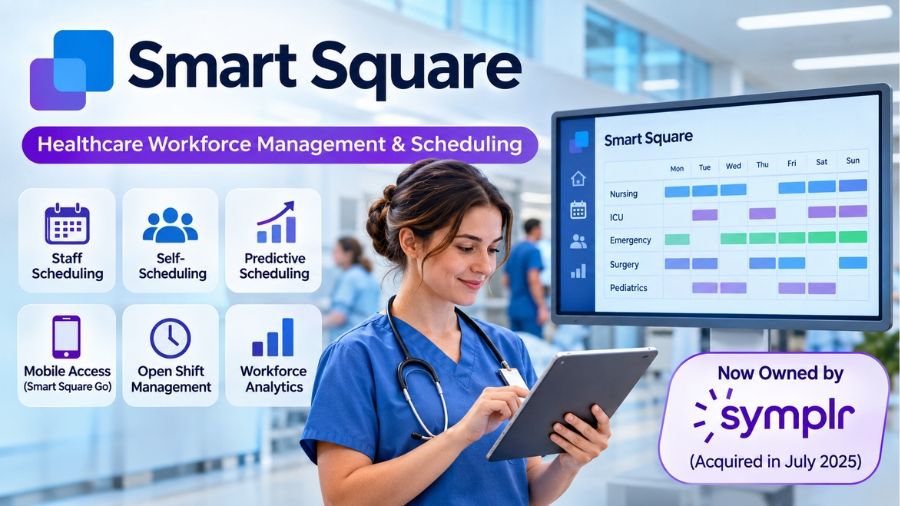
Smart Square is a cloud-based healthcare workforce scheduling and management solution that helps hospitals coordinate employees, manage shift coverage, and anticipate staffing requirements. Unlike basic calendar applications, it is designed around the operational needs of healthcare facilities, where staffing levels, professional qualifications, departmental requirements, and patient demand can change throughout the day. The platform supports nurse and staff scheduling by bringing workforce information together in a centralized system. Hospital administrators can use it to organize schedules, monitor staffing availability, manage open shifts, and make adjustments when departments experience unexpected shortages. Employees can also use supported self-service features to interact with their schedules and manage certain scheduling requests. Smart Square is now part of symplr’s healthcare operations software portfolio, making it an important solution for organizations looking to modernize workforce management.
Who Owns Smart Square?
Smart Square has an ownership history connected to several healthcare technology companies. The technology originated with Avantas, a company known for workforce optimization solutions, before becoming associated with AMN Healthcare. AMN Healthcare subsequently developed and marketed Smart Square as part of its healthcare workforce technology offerings. On July 2, 2025, symplr announced that it had acquired the Smart Square scheduling software from AMN Healthcare. The transaction was completed on July 1, 2025, with a reported purchase price of $75 million. This included $65 million paid at closing and a $10 million note. The acquisition strengthened symplr’s position in healthcare workforce management by adding an established nurse and staff scheduling solution to its existing technology portfolio. AMN Healthcare also entered into a commercial partnership with symplr, allowing the companies to maintain a relationship between their respective workforce solutions.
How Does Smart Square Work?
Smart Square works by bringing together workforce scheduling information and organizational staffing requirements in one centralized environment. Healthcare administrators can use the system to establish scheduling requirements, organize employees, and monitor staffing coverage across departments. The platform uses workforce data and predictive analytics to help managers anticipate future staffing requirements rather than relying exclusively on last-minute scheduling decisions. For example, a hospital department expecting increased patient demand may need additional nurses during particular shifts. Smart Square can help staffing teams identify these requirements earlier and plan appropriate coverage. Employees can interact with available scheduling functions, depending on their organization’s configuration and permissions. When an employee requests time off, trades a shift, or expresses interest in an available shift, the request can be managed through supported workflows. The overall objective is to make workforce coordination more predictable, transparent, and manageable for both employees and administrators.
Key Features of Smart Square
Smart Square offers several capabilities designed around the practical challenges of healthcare staffing. Its features combine workforce forecasting, automated scheduling, employee self-service, and staffing analytics to support hospital operations. Rather than treating employee schedules as isolated calendars, the software connects scheduling decisions with broader workforce requirements, helping organizations understand where coverage is needed and how available employees can be deployed.
AI-Powered Predictive Scheduling
Predictive scheduling is one of the platform’s important capabilities. Smart Square uses AI-driven analytics to help healthcare organizations forecast staffing requirements in advance. According to symplr, its predictive scheduling technology can forecast workforce needs up to 120 days ahead, with the company advertising 96% forecasting accuracy. These capabilities are intended to help staffing managers identify potential shortages before they become urgent operational problems. Forecasting can support more informed decisions about employee availability, department requirements, and shift coverage. However, predictions are not guarantees, as actual staffing needs can change because of unexpected patient demand, employee absences, and other operational circumstances. The value of predictive scheduling lies in giving managers additional information and preparation time.
Employee Self-Scheduling
Self-scheduling gives eligible healthcare employees more involvement in organizing their working hours. Instead of depending entirely on managers to assign every shift, staff members may be able to select available shifts according to their organization’s scheduling rules. This approach can provide greater flexibility while helping administrators maintain appropriate staffing coverage. Smart Square supports self-scheduling and cyclic scheduling capabilities, allowing organizations to configure different scheduling approaches for their workforce. Employees may have different levels of scheduling access depending on departmental policies, employment arrangements, and organizational requirements. A well-managed self-scheduling process can improve transparency and give healthcare professionals greater visibility into their working commitments.
Open Shift Management
Open shift management helps hospitals identify and fill staffing gaps when scheduled employees are unavailable or additional coverage becomes necessary. Smart Square includes automated open-shift management tools that can communicate available opportunities to eligible employees. Its platform also supports variable incentives designed to encourage employees to accept particular shifts while helping organizations remain mindful of labor budgets. This is especially useful in healthcare environments where an uncovered shift can create operational pressure for an entire department. Rather than relying exclusively on manual phone calls and individual messages, staffing teams can use centralized workflows to manage available shifts. The actual process and incentives depend on the policies established by each healthcare organization.
Workforce Analytics and Reporting
Workforce analytics help hospital administrators understand staffing performance and identify areas requiring attention. Smart Square provides reporting and productivity analytics that allow managers to review workforce utilization, staffing coverage, and operational patterns. These insights can help organizations evaluate whether their current scheduling arrangements are meeting departmental requirements. For example, administrators may identify departments that regularly depend on additional staffing or experience recurring coverage gaps. They can then use this information when reviewing scheduling strategies and resource allocation. Reporting also supports more informed workforce planning because decisions can be based on available operational data rather than assumptions alone.
Enterprise-Wide Workforce Deployment
Large healthcare organizations often operate multiple hospitals, departments, and clinical facilities. Managing staffing independently at every location can make it difficult to understand the organization’s overall workforce position. Smart Square offers enterprise-wide workforce deployment capabilities that help organizations coordinate available labor across facilities and departments. Features such as resource pools and float teams can support more flexible staffing arrangements. This approach can help administrators identify where additional employees are required and where available resources might be used more effectively. The ability to view workforce requirements across an organization is particularly valuable for healthcare systems managing complex staffing operations.
On-Call Scheduling and Rapid Shift Recruitment
Healthcare facilities sometimes require additional employees at short notice because of unexpected absences or changing operational requirements. Smart Square supports on-call scheduling and rapid shift recruitment capabilities to help organizations respond to these situations. Administrators can manage on-call requirements and communicate available opportunities to appropriate employees. Rapid notifications can reduce the time required to identify potential shift coverage. Although these tools cannot eliminate unexpected staffing challenges, they can provide a more organized approach to handling urgent scheduling requirements.
What Is Smart Square Go?
Smart Square Go is the mobile application associated with the Smart Square workforce scheduling platform. It is designed to extend scheduling functionality beyond the traditional desktop experience, allowing authorized healthcare professionals to manage supported scheduling activities through their mobile devices. The application is particularly useful for employees who want to check available shifts, review scheduling notifications, and submit requests without accessing a hospital computer. Smart Square Go requires an active Smart Square account, meaning users generally need access provided by their healthcare organization. Its availability and functionality may depend on the organization’s configuration and authentication arrangements.
Main Features of Smart Square Go
Smart Square Go offers several practical features for clinicians. Employees can review available shifts and pick up opportunities that fit their schedules when their organization enables the functionality. The application also supports personal calendar synchronization, helping users keep their work commitments organized alongside other appointments. Another useful capability is the ability to submit time-off requests, trade shifts, and request to work through supported scheduling workflows. Its notification hub provides a centralized place for scheduling announcements, while authentication options include Single Sign-On and Active Directory support. These features make the application a convenient extension of the broader scheduling platform, although the precise permissions available to each employee are controlled by their organization.
How to Access Smart Square Login
Accessing Smart Square generally requires an account issued or authorized by a participating healthcare organization. Unlike consumer applications that offer a universal registration process, Smart Square is an enterprise platform with organization-specific access arrangements. Employees should obtain their correct login address and account information from their hospital’s staffing department or IT support team.
Smart Square Login Process
The login process normally begins by opening the Smart Square portal provided by the healthcare organization. Users enter their assigned credentials and complete any additional authentication requirements configured by their employer. Once successfully authenticated, they can access the scheduling functions available to their account. Depending on their permissions, these may include viewing upcoming shifts, checking scheduling information, submitting requests, and reviewing available shift opportunities. Employees should avoid using unofficial login websites or sharing their account credentials with other people.
What If Smart Square Login Is Not Working?
Login problems can occur for several reasons, including incorrect passwords, expired credentials, account restrictions, or authentication issues. Some organizations also require employees to access Smart Square through a designated internal portal or approved authentication system. Users experiencing difficulties should first confirm that they are using the correct organizational login address. They can then check their credentials and follow their employer’s password recovery process. If the problem continues, contacting the hospital’s IT department or designated Smart Square administrator is generally the most appropriate solution. Employees should not attempt to bypass organizational security controls or use another person’s account.
Benefits of Smart Square for Hospitals and Healthcare Employees
Smart Square offers potential advantages for both healthcare organizations and their employees. For hospital administrators, centralized workforce scheduling can reduce administrative complexity and improve visibility into staffing requirements. Predictive analytics can support earlier planning, while open-shift management can help teams respond to coverage gaps. Workforce reporting also provides information that can assist with reviewing staffing utilization and labor expenses. For healthcare professionals, self-scheduling and mobile access can make certain scheduling activities more convenient. Employees may gain better visibility into available shifts and have additional ways to communicate scheduling preferences. However, the benefits depend on how effectively an organization implements the platform, configures its policies, and trains employees to use its features. Technology can support better workforce decisions, but it cannot replace appropriate staffing policies, professional judgment, or effective communication between hospital teams.
Smart Square vs Traditional Hospital Scheduling Systems
Traditional hospital scheduling often involves spreadsheets, paper-based rosters, emails, telephone calls, and separate departmental calendars. Although these methods can work for smaller facilities, they may become difficult to manage as healthcare organizations grow. Administrators can spend considerable time updating schedules, communicating changes, and checking employee availability. Smart Square offers a more centralized approach by combining scheduling information, workforce analytics, and automated shift-management capabilities. Its predictive features also provide a planning dimension that basic scheduling tools may not offer. Nevertheless, implementing a specialized platform requires organizational investment, employee training, data management, and integration with existing systems. Traditional methods may remain sufficient for smaller organizations with straightforward staffing arrangements, while larger healthcare systems may benefit more from dedicated workforce management software. The right choice depends on operational complexity, available resources, and the organization’s specific requirements.
Smart Square Integration With Other Healthcare Systems
Healthcare organizations often use several technology platforms to manage employees, payroll, patient information, and operational activities. A scheduling solution becomes more useful when it can exchange relevant information with these existing systems. Smart Square supports integration with HR, payroll, timekeeping, and electronic medical record systems. According to symplr, the platform integrates with more than 30 HR, payroll, and EMR systems. These connections can help reduce duplicated data entry and improve consistency between workforce records and scheduling information. For example, relevant employee information maintained in an HR system may support scheduling workflows, while connections with timekeeping systems can help align scheduled hours with attendance processes. However, integration availability depends on the systems involved, implementation requirements, and the configuration established by the healthcare organization.
Challenges and Limitations of Smart Square
Although Smart Square provides advanced workforce management capabilities, organizations should consider several practical challenges before implementing it. The first is implementation complexity. Large hospitals may need to coordinate software configuration, employee information, scheduling policies, and integrations across multiple departments. Another challenge is employee adoption. Healthcare professionals who are accustomed to traditional scheduling methods may require training before they become comfortable with a new digital platform. Data quality is also important because inaccurate workforce records or incomplete availability information can affect scheduling decisions and forecasts. Furthermore, predictive analytics cannot anticipate every unexpected event, such as sudden increases in patient demand or widespread employee absences. Organizations must continue monitoring staffing conditions and making appropriate operational decisions. Subscription costs, implementation requirements, technical support, and integration expenses should also be evaluated when comparing Smart Square with alternative workforce management solutions.
The Future of Smart Square and Healthcare Workforce Management
Healthcare workforce management is increasingly influenced by automation, predictive analytics, and integrated operational software. Smart Square’s acquisition by symplr in 2025 represents an important development in this area because it brings the scheduling platform into a broader healthcare operations technology portfolio. Its predictive scheduling, workforce deployment, and open-shift management capabilities align with the industry’s growing interest in using technology to improve staffing efficiency. Future developments may involve deeper integration between workforce planning, timekeeping, employee management, and other hospital systems. However, the long-term value of these capabilities will depend on implementation quality, data reliability, regulatory requirements, and the practical needs of healthcare professionals. AI-powered scheduling should be viewed as a tool that supports human decision-making rather than an independent replacement for experienced staffing managers.
Conclusion
Smart Square has developed into an important healthcare workforce management solution, helping hospitals organize employee schedules, anticipate staffing requirements, manage open shifts, and improve workforce visibility. Its combination of predictive analytics, self-scheduling, workforce reporting, and mobile scheduling through Smart Square Go addresses several challenges associated with managing modern healthcare teams. The 2025 acquisition by symplr also established a new chapter in the platform’s development, placing it within a broader portfolio of healthcare operations technology. Although successful implementation requires reliable data, employee training, and appropriate organizational policies, Smart Square provides healthcare organizations with a centralized approach to workforce planning. Its significance lies in helping hospitals make more informed staffing decisions while giving authorized healthcare professionals convenient access to important scheduling tools.
FAQs
1. What is Smart Square used for?
Smart Square is used by hospitals and healthcare organizations to manage employee schedules, coordinate nurse staffing, forecast workforce requirements, and handle available shifts.
2. Is Smart Square owned by AMN Healthcare?
No. symplr acquired Smart Square from AMN Healthcare in July 2025, becoming its owner and integrating the software into its healthcare operations portfolio.
3. What is Smart Square Go?
Smart Square Go is a mobile application that allows authorized clinicians to manage schedules, request time off, trade shifts, and receive notifications.
4. Can nurses access Smart Square from home?
Yes, nurses can access Smart Square remotely when their healthcare organization permits external access and provides the necessary login credentials and authentication arrangements.
5. Is Smart Square free to use?
Smart Square is enterprise software primarily licensed to healthcare organizations. Individual employees generally access its features through their employer rather than purchasing subscriptions.
6. Does Smart Square use artificial intelligence?
Yes. Smart Square uses AI-driven predictive analytics to help healthcare organizations forecast staffing requirements, manage open shifts, and make informed workforce scheduling decisions.
More read: ABCya3